




General relativity survives its most rigorous single-event test yet
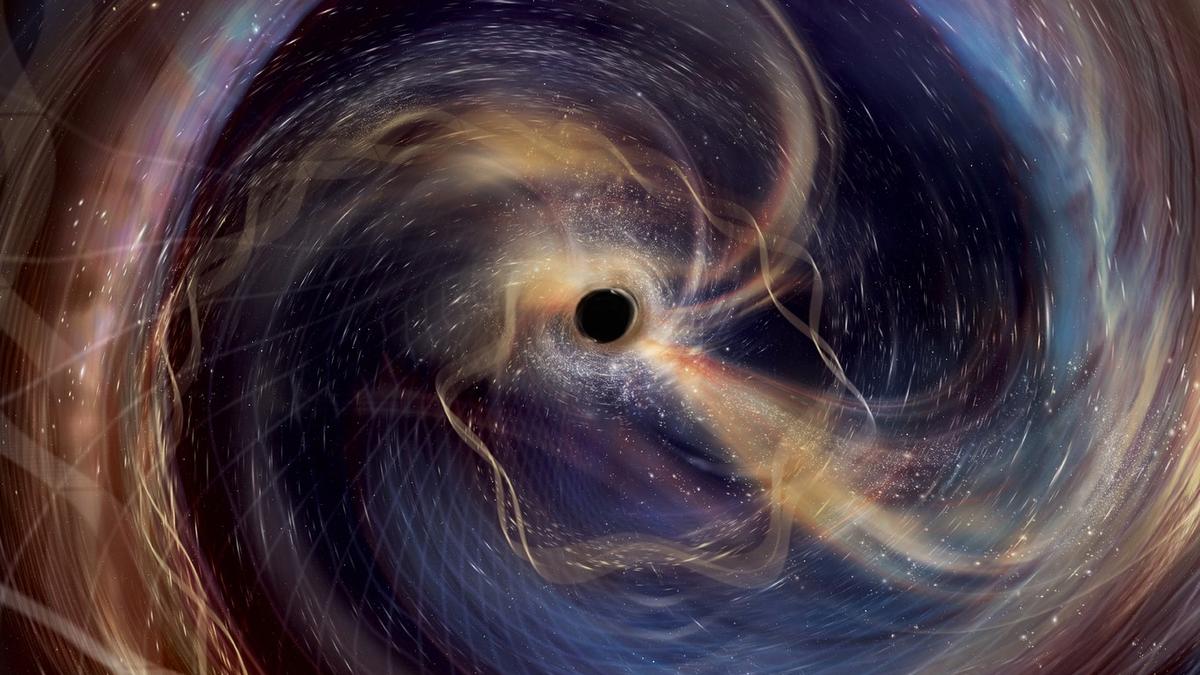
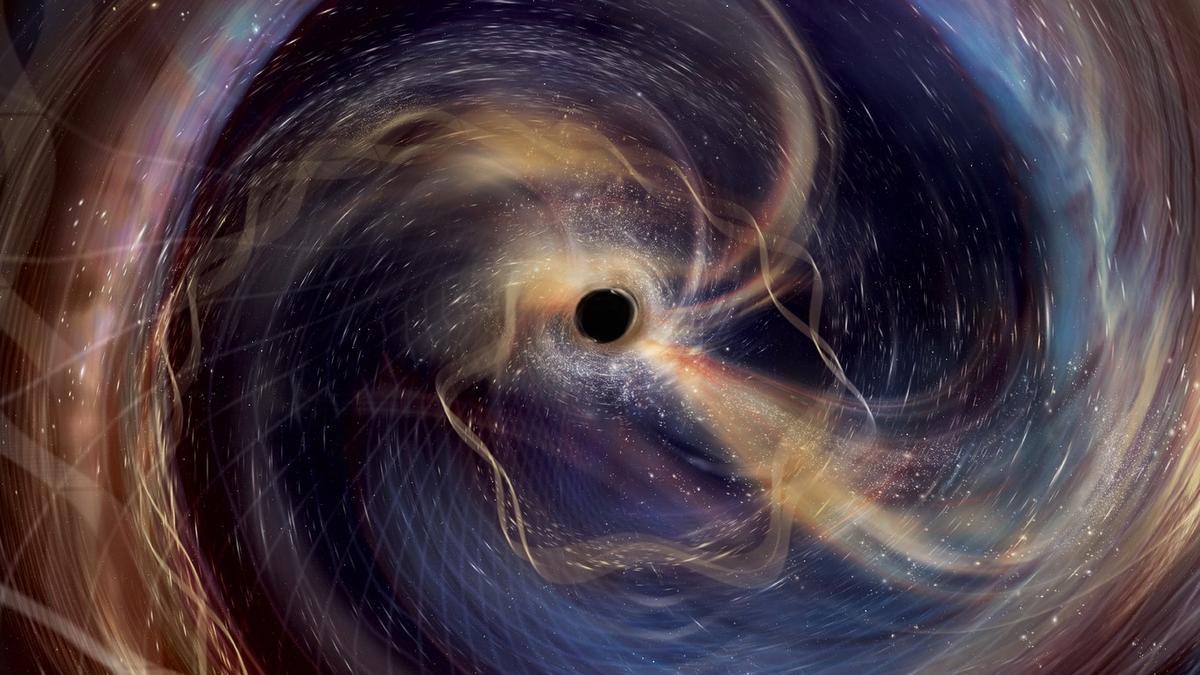
This artwork imagines the event designated GW250114, which produced the clearest gravitational wave signal the LIGO instruments have detected to date.
| Photo Credit: Aurore Simonnet (SSU/EdEon)/LVK/URI
On January 14, 2025, the Laser Interferometer Gravitational-wave Observatories (LIGOs) recorded a cosmic tremor unlike any before. Named GW250114, the signal was the ‘loudest’ gravitational wave scientists had ever detected.
In a study published in Physical Review Letters on January 29, an international team of researchers reported that it had used this powerful signal to conduct the most rigorous test of Albert Einstein’s general theory of relativity and the nature of black holes to date.
For more than a century, the theory, also called general relativity, has been the gold standard for understanding gravity. It predicts that when two black holes merge, they will form a single, distorted survivor that settles down by ‘ringing’, much like a bell that has been struck, emitting gravitational waves in a process called ringdown.
According to the no-hair theorem, a black hole in vacuum can be characterised only by its mass and spin. This means its ‘ringing’ should follow a specific, predictable pattern, which is called the Kerr metric. The researchers wanted to use the exceptional clarity of GW250114 to check whether black holes truly are as simple as Einstein predicted or if they hide more complex features that might point to new physics.
To analyse the signal, the researchers used a technique called black hole spectroscopy. Just as astronomers can identify elements in stars by looking at the specific frequencies of light they emit, gravitational-wave scientists look for specific frequencies and decay times in the ‘sound’ of a black hole’s ringdown.
The team also used several advanced mathematical tools. Software packages called RINGDOWN and pyRing were used to fit specific models to the post-merger data to identify individual notes in the signal. A method called pSEOBNR analysed the entire signal to check if its beginning and end told a consistent story.
The researchers also compared the real-world data against supercomputer simulations of black hole mergers to see how well they matched, a technique called numerical relativity.
The study’s results were a resounding victory for general relativity. The team successfully identified at least three distinct ‘notes’ in the black hole’s ringing, the dominant tone, its first overtone, and a mode at a higher pitch.
The frequencies and damping times of these modes matched the predictions for a Kerr black hole within just a few percent. Because the signal was so loud, the single event also allowed the team to run other tests that were 2-3 times more stringent than previous studies that combined dozens of weaker events.
The data also confirmed Hawking’s area theorem — which states that a black hole’s surface area can’t decrease — at a high statistical significance of 4.8 sigma.
“In summary, the single, loud event GW250114 has yielded the scientific return of dozens of previous detections, offering a preview of the unprecedented science that upcoming LIGO-Virgo-KAGRA observing runs will unlock,” the researchers wrote in their paper.
A new LIGO observatory, the third after the two in the U.S., is coming up in Maharashtra. Once it’s online it’s expected to improve the precision with which the network of observatories can identify the source of gravitational waves by an order of magnitude.
Published – February 03, 2026 06:05 am IST