




Donut Lab’s Latest Battery Test Proves It Isn’t A Supercapacitor
Finnish startup Donut Lab released its third independent test result Monday, the latest in a series of weekly rollouts related to what it claims is the world’s first production-ready all-solid-state battery. This time, the test takes aim at a specific question: Is the Donut battery actually a supercapacitor in disguise?
To answer that, the company released what it calls a “self-discharge performance test.” But to understand why Donut felt the need to put the supercapacitor question to rest, it helps to rewind a bit. When the Finnish startup unveiled its battery at the Consumer Electronics Show in January, the specifications shocked the battery industry. How could an unknown company leapfrog Toyota, Factorial, and CATL in the solid-state race?

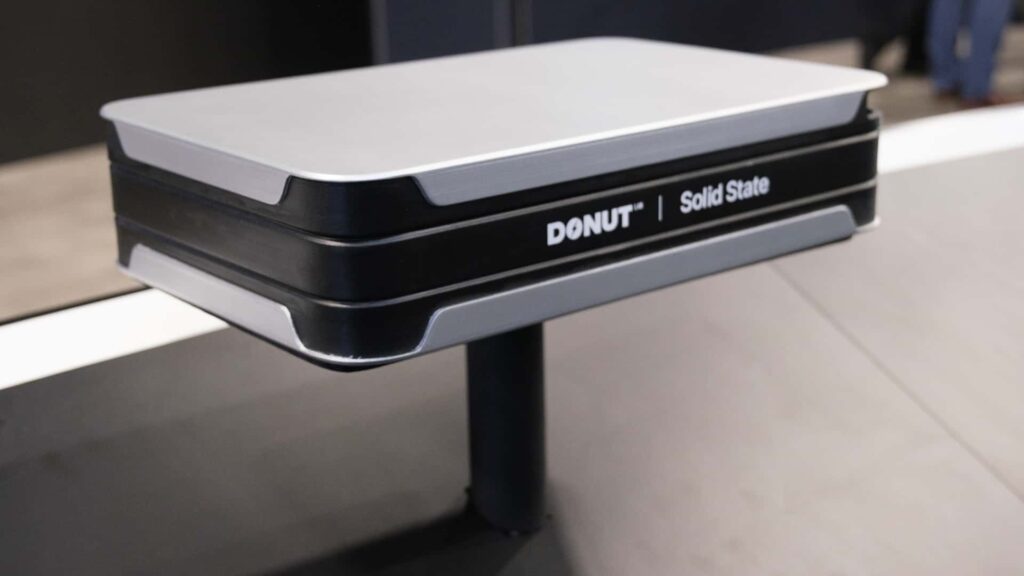
Photo by: Donut Lab
The startup claimed 400 watt-hours per kilogram of energy density, a 100,000-cycle lifespan and a charge time of roughly five minutes. Some internet sleuthing at the time revealed that a Donut Lab-linked renewables company called Nordic Nano had developed a supercapacitor, with the exact same energy density figure, for solar and storage applications. (Nordic Nano has since taken that report down from its website.)
Donut Lab pushed back on those claims, which brings us to Monday’s test, again conducted by VTT Technical Research Centre of Finland.
There’s a very clear distinction between a battery and a supercapacitor. Both store energy, but they do it differently. A battery relies on chemical reactions inside the cell. A supercapacitor stores energy in an electrical field, enabling rapid charge and discharge. But when left idle, it bleeds charge quickly. Batteries, by contrast, can hold a charge for far longer.
Photo by: Donut Lab
To prove just that, the researchers charged the cell to 50% capacity, left it to idle for 240 hours, and then measured how much energy was remaining in the cell. The cell showed very little voltage drop over that period and retained nearly 98% of the energy stored before the idle period began. In plain terms, it behaves like a battery, not a capacitor.
Donald R. Sadoway, Professor Emeritus of Materials Chemistry at the Massachusetts Institute of Technology, confirmed as much to InsideEVs. “Super capacitors can give great power bursts but only for a short time duration,” he said, adding that the Donut battery does not appear to be one.
But Sadoway stopped well short of endorsing the broader claims. He noted that the report was too generic and lacked the depth needed to back Donut’s claims of an extraordinary breakthrough.
The startup has been releasing limited information every week, but so far, none of the tests have actually demonstrated that the cell is solid-state. The first test set out to prove that the individual cell could fully charge in under ten minutes. The second test put it through temperatures as high as 100 degrees Celsius (212 degrees Fahrenheit). The battery passed both exams, at least in the lab, and for a handful of cycles.
Battery scientists InsideEVs spoke to remained unconvinced, arguing that lab-scale results only tell part of the story. For real-world relevance, the cells need to perform the same way at the pack level for thousands of cycles.
“The report is too vague to be considered credible,” Sadoway said. “Remarkable claims demand remarkable proof.”
Contact the author: suvrat.kothari@insideevs.com