
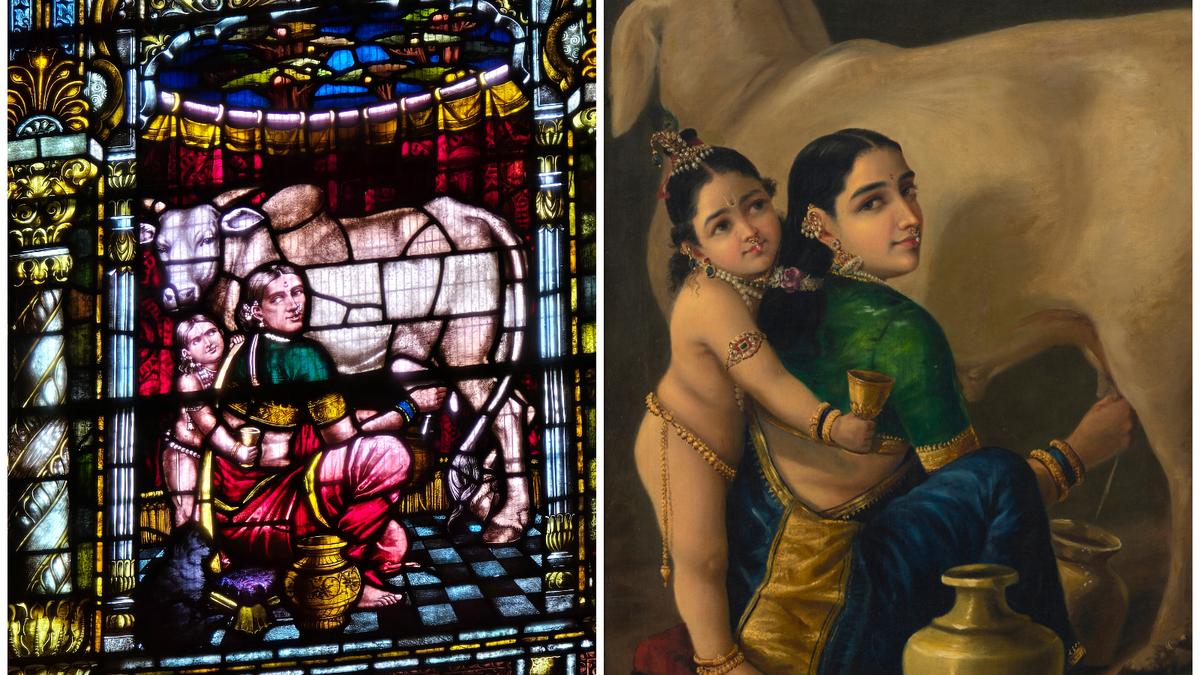
Did Raja Ravi Varma paint the Yashoda and Krishna image first? The ₹167-crore puzzle
When I curated Bhakti: The Art of Krishna at the Nita Mukesh Ambani Cultural Centre in 2024, one of the most quietly compelling works on view was Raja Ravi Varma’s Yashoda and Krishna. For many in Mumbai, it was the first time encountering the painting in person. Today, as the work emerges from a private collection and enters the auction circuit, it carries with it not just aesthetic value, but historical and financial weight.
And yet, what interests me most about this painting is not its price, nor even its authorship — but a question that remains unresolved.
Art history is rarely complete. It is constructed through objects, documents, and institutional consensus, but also through gaps — moments where the narrative does not fully close. Yashoda and Krishna is one such moment.
By no means am I attempting to question whether this painting is a Ravi Varma or not. It is now accepted as one — and in the world of art, acceptance often becomes its own form of truth. But history has shown us that acceptance and certainty are not always the same. The case of Salvator Mundi, sold as a Leonardo da Vinci and later subjected to intense scholarly doubt, reminds us that belief, market validation, and authorship do not always align neatly.
The question here is not whether this is a Ravi Varma. The question is: where does this image come from?
My own uncertainty began not with the painting, but with stained glass.
In the Darbar Hall of the Lakshmi Vilas Palace in Vadodara, one encounters a remarkable series of stained-glass windows, commissioned in the late 19th Century and executed by European workshops. Among them is a panel depicting a mother and child — unmistakably Yashoda and Krishna — rendered with a softness, intimacy, and emotional clarity that feels strikingly close to Ravi Varma’s visual language but not close enough.
And when one looks at the surrounding panels, the coherence breaks down.
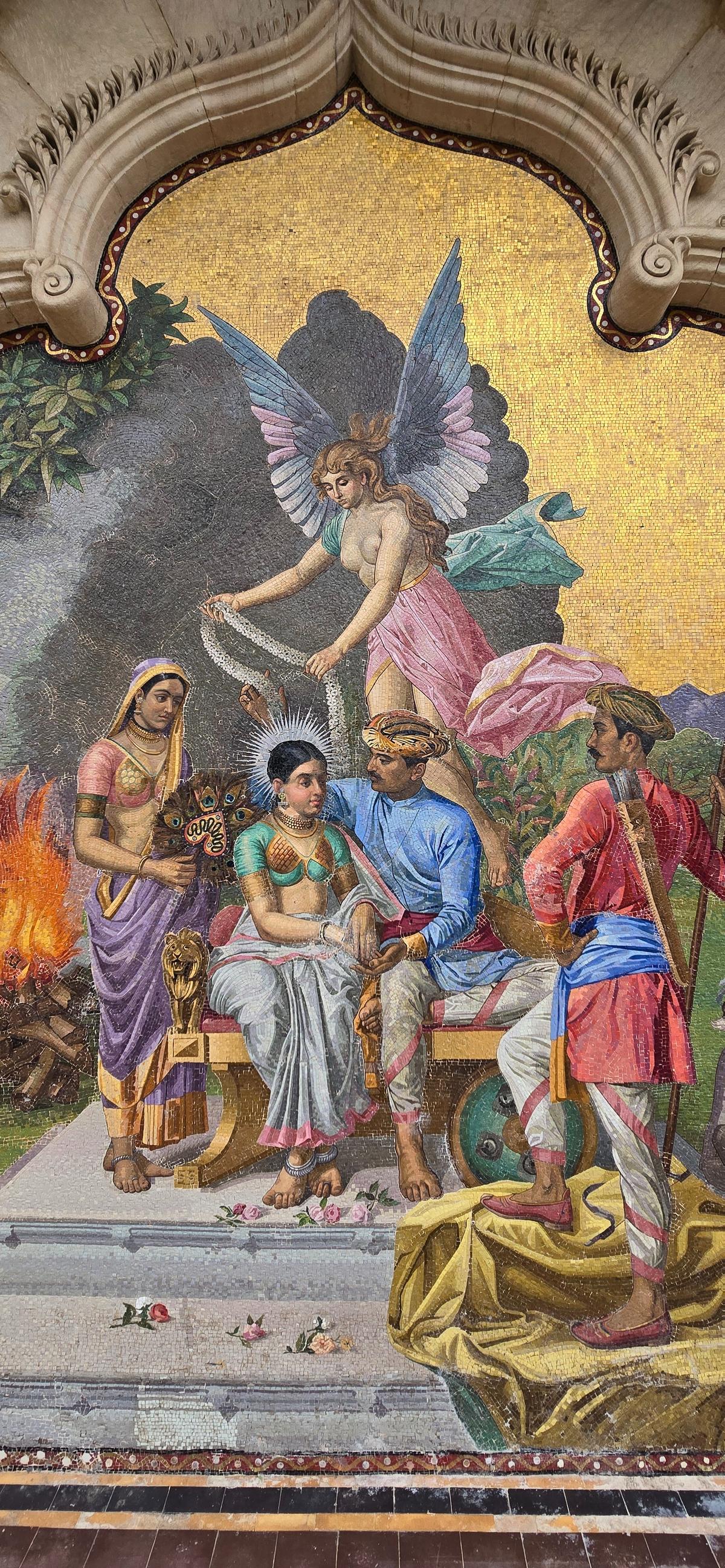
Italian Mosaic Panel, Laxmi Vilas Palace, Baroda
| Photo Credit:
SPECIAL ARRANGEMENT
The Vishnu images in the same hall, accompanied by figures such as Garuda and Hanuman, appear to have been executed by artists who did not fully grasp the internal logic of Hindu iconography. The figures feel translated rather than understood — constructed from reference, but lacking fluency. These are not images born from within the tradition, but interpretations of it. And so, the Yashoda-Krishna panel is not different. Its emotional register, its humanisation of the divine, its compositional intimacy — all of this aligns closely with what Ravi Varma was doing in the late 19th Century, but who did it first?
This is where the puzzle begins.
If one examines Ravi Varma’s Baroda-period works from the 1880s and 1890s — especially those associated with palace commissions — they tend toward large-scale, formal, narrative compositions. Yashoda and Krishna, by contrast, is smaller, quieter, and more devotional in tone. Its scale, subject, and finish sit somewhat outside the expected framework of those commissions.
At the same time, the painting bears the unmistakable signatures of Ravi Varma’s practice. He was self-taught, and his work often reveals anatomical inconsistencies. Figures are frequently resolved through drapery, jewellery, and staging rather than strict structural accuracy. In Yashoda and Krishna, one notices these tendencies clearly: the child’s body is only partially articulated, Yashoda’s seated posture is not entirely convincing, and the cow, while narratively present, is not structurally integrated. To me, it feels like Ravi Varma tried to copy the stained glass but still there is a major gap in what we know he painted in Baroda, as they remain on display there, and this Yashoda – Krishna. Curiously, the stained glass appears, in some respects, to resolve these elements more clearly. The cow is more legible. The spatial arrangement is more direct. And yet, the faces — the tenderness, the emotional core — seem deeply aligned with the Ravi Varma idiom.
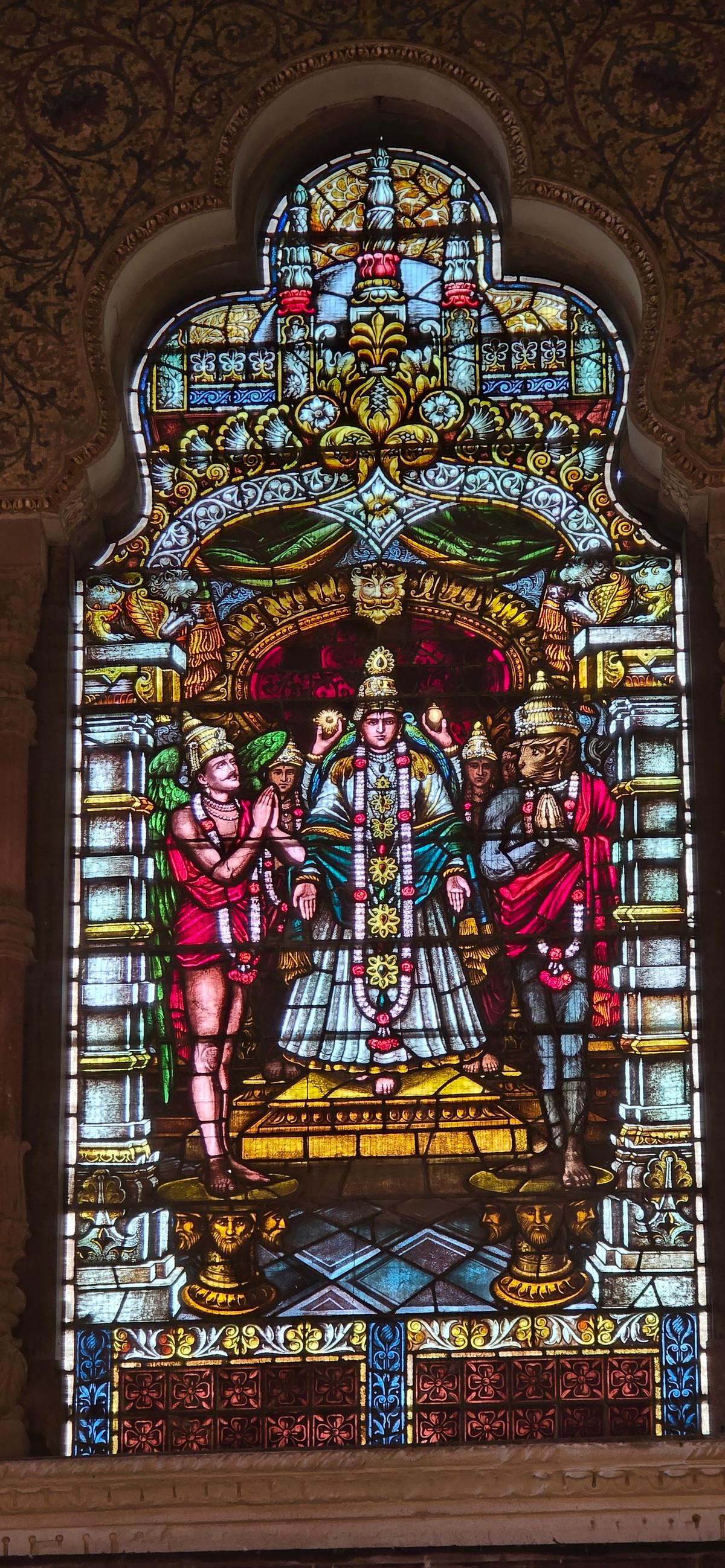
Vishnu with Garuda and Hanuman, Stained Glass, Laxmi Vilas Palace, Baroda
| Photo Credit:
SPECIAL ARRANGEMENT
So which came first?
Did Ravi Varma, aware of the palace commission, create a compositional drawing — a prototype — that was sent to the stained-glass workshop in Europe? Or did the stained-glass image exist independently, later inspiring a painted version? Or are both derived from a now-lost visual source that circulated between court, studio, and workshop?
My own considered view is: Ravi Varma likely created a drawing or compositional cartoon of Yashoda and Krishna, which was shared with the stained-glass makers. What we see in Vadodara is not the original image, but its translation into another medium — filtered through another hand.
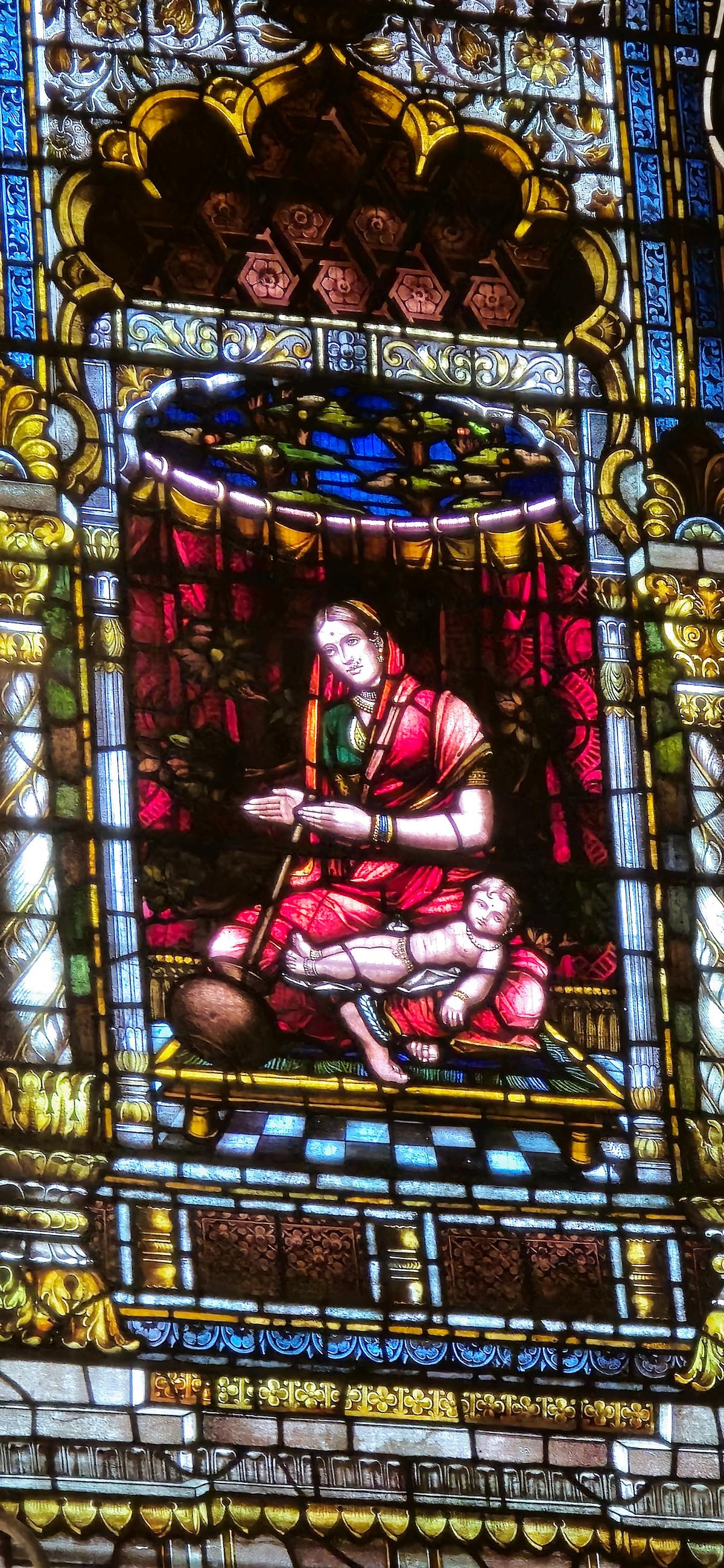
Yashoda Churning Butter, Laxmi Vilas Palace, Baroda
| Photo Credit:
SPECIAL ARRANGEMENT
The story does not end there
After Ravi Varma’s death in 1906, his brother and the Ravi Varma Press played a central role in reproducing and disseminating his imagery. Many works associated with Ravi Varma — including those that have appeared at auction in recent years — belong to a broader ecosystem of production involving studio assistants, family members, and printmakers. The boundary between the master’s hand and the workshop’s output is often blurred.
Which brings us back to the present.
There are scholars who have studied Ravi Varma’s diaries in detail. There are catalogues, archives, and institutional histories. And yet, this particular connection — between the Darbar Hall stained glass and the painting — remains unexamined.
It is a small gap, perhaps. But an important one.
Because today, this question is no longer just academic.
It is, quite literally, a question worth ₹167 crores.
Ashvin E Rajagopalan is an art historian and associate curator of the India Pavilion at the Venice Biennale 2026, and director at Piramal Museum of Art and Ashvita’s.
Published – April 04, 2026 06:04 pm IST