

Consumers get a raw deal as global oil price fall benefit remains ‘frozen’
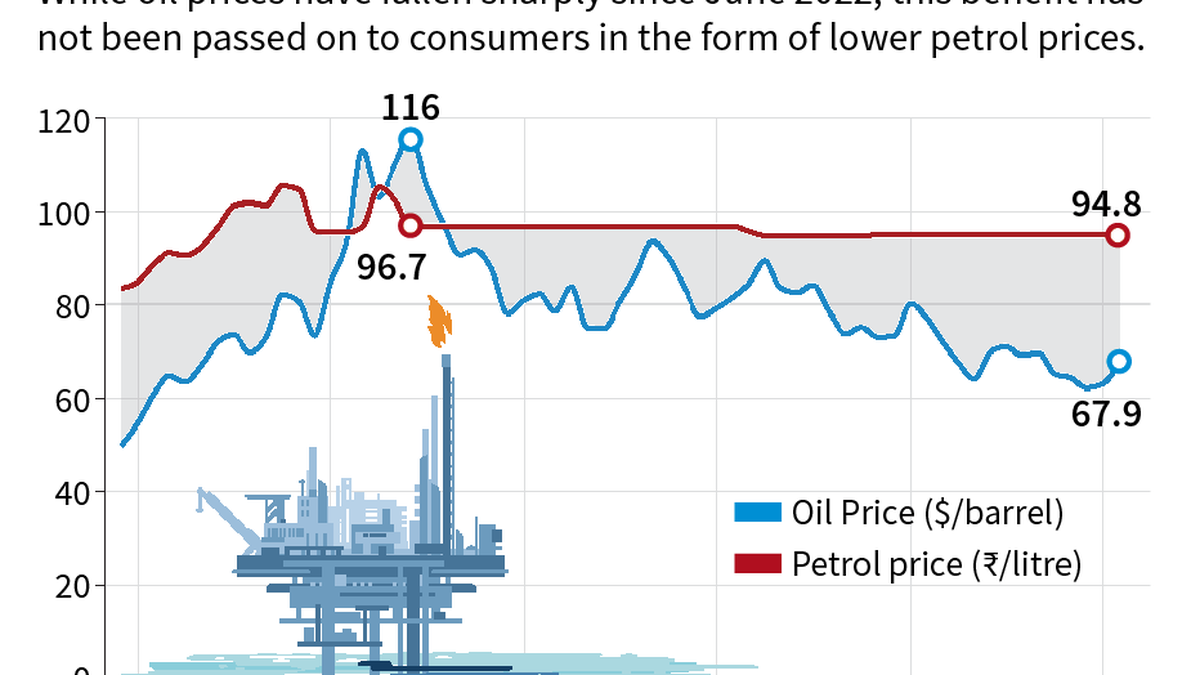
The price of petrol sold in India has been reduced 1.9% since June 2022, even as the price of oil has fallen 41.5% since then, an analysis by The Hindu of official data shows.
Data from the Petroleum Planning and Analysis Cell (PPAC) shows that the price of oil, as captured by the Indian basket of crude oil, rose to over $100 a barrel in the period March-July 2022, soon after Russia invaded Ukraine in February that year.
Frozen prices
In response to this spike, oil marketing companies (OMCs) increased the price of petrol to ₹105.1 per litre by April 2022. Following this, however, they froze prices at ₹96.7 per litre in May 2022 when average oil prices jumped to around $110 a barrel. Fuel prices were kept unchanged for more than 21 months thereafter, until mid March 2024.
This freeze, however, marked an unofficial digression from the official dynamic pricing policy the government had adopted in 2017 for petrol under which OMCs were to fix the price of fuel on a daily basis based on prevailing oil prices.
Oil prices rose to $116 a barrel by June 2022. Since then, however, the price of oil available to India for purchase has fallen to an average of $67.9 a barrel by February 2025, a 41.5% fall. During this period, the price of petrol sold in India was reduced from ₹96.7 a litre to ₹94.8 a litre, a 1.9% reduction.
The Ministry of Petroleum and Natural Gas has repeatedly informed Parliament that the setting of fuel price is the exclusive domain of the OMCs, and that the government has no part to play in this.
‘Based on convenience’
According to energy sector analysts and experts, the OMCs have in the past passed on oil price hikes to consumers in the form of higher petrol prices, but have not passed on the benefits of falling oil price.
“In a regulated system, the consumer would have been insulated from both kinds of shocks,” Rohit Azad, Professor at the Centre for Economic Studies and Planning at the Jawaharlal Nehru University (JNU), said. “However, in this case, when crude oil prices go up, it is passed on to consumers, but when it goes down, it is not reflected in the prices. It is a mechanism based on convenience.”
Role of excise duty
Notably, even the 1.9% reduction in petrol prices since June 2022 has been due to cuts in taxes on fuel rather than actions by OMCs to reduce the underlying price of petrol.
That is, the excise duty on petrol was cut in mid-March 2024 by ₹2/litre, reducing the price from ₹96.7/litre to ₹94.7/litre. Since then, the price has increased marginally to ₹94.8/litre.
In response to a query in Parliament, Minister of State for Petroleum and Natural Gas Suresh Gopi pointed out that, despite there being a ₹2 per litre hike in the excise duty of petrol in April 2025, this was not passed on to consumers.
India’s largest state-run OMC, IndianOil Corporation, did not respond to a request for comment.
Published – February 13, 2026 09:37 pm IST