



Charged EVs | Next year, your luxury Uber robotaxi may be a Lucid; how it all came together
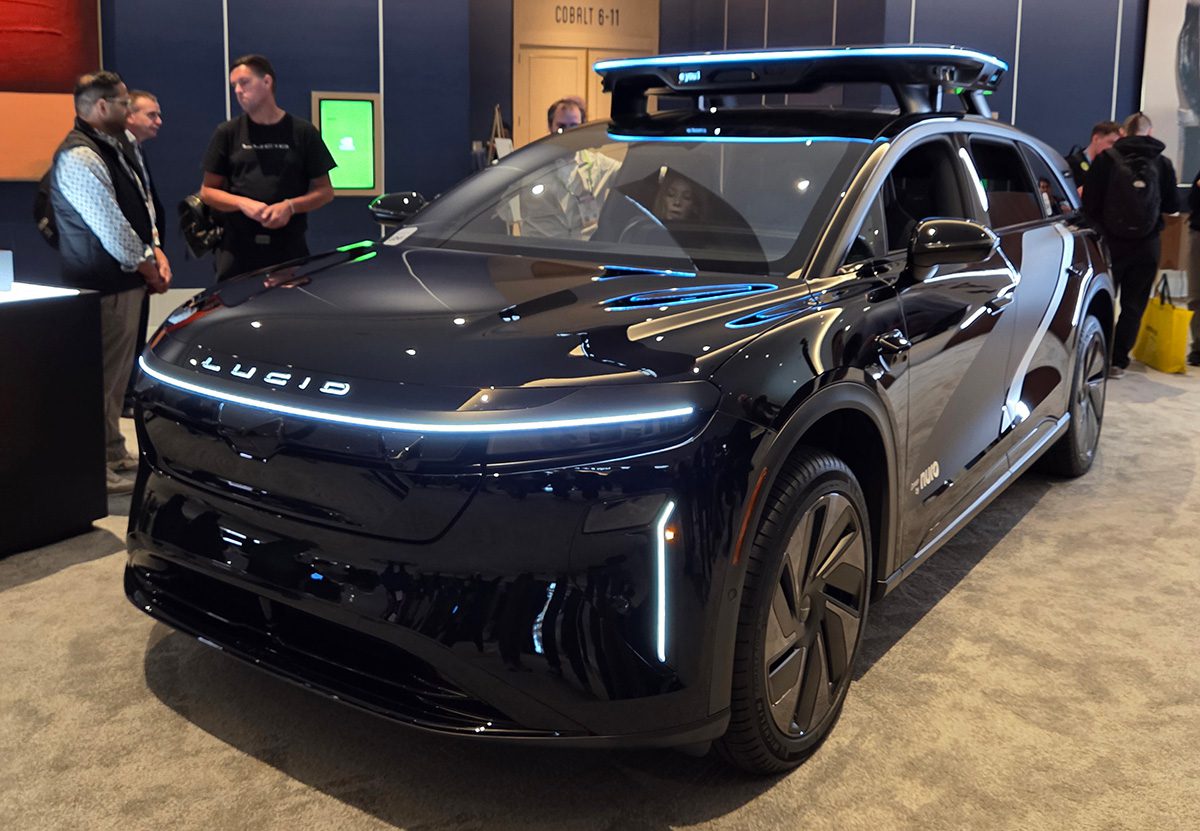
From the sensor-packed ‘tiara’ on the roof to the Nuro software stack providing autonomous driving, the Lucid Gravity met all the qualifications for a self-driving luxury Uber.
Lucid’s robotaxi is ready for the road—except for one small detail. It still needs to fit the microsprayers that will clean its various sensors to ensure they work in bad weather. Once that happens, and final safety testing is finished, they are scheduled to go into service by December.
Earlier this year at CES, EV maker Lucid and autonomous-vehicle software developer Nuro jointly showed the production-intent robotaxi, based on the Lucid Gravity electric SUV, that Uber plans to deploy in San Francisco before the end of this year. We spoke to Lucid’s acting CEO Marc Winterhoff and its design director Derek Jenkins to learn how the design and the partnership came together.
The massive deal was first announced last July. Lucid, Uber, and Nuro agreed that Uber would buy and deploy 20,000 Lucid vehicles as robotaxis over six years. Lucid would build the cars, replacing its own driver-assist software with Nuro’s software stack, and fitting the cars with Nuro’s suite of sensors for self-driving. Uber, meanwhile, would make “multi-hundred-million dollar investments” in both companies.
Production intent, minus one detail
The vehicle shown at CES represents the Gravity robotaxis that will go into service within the year. Except, that is, for one detail. Derek Jenkins, Lucid’s senior VP of design, noted the various sensors did not have the “microsprayer” cleaners that will keep them clean in rain, snow, ice, dust, and other climatic extremes—a necessity for reliable robotaxi operation.
The Gravity on display otherwise had three sets of physical modifications to take it from a production EV with Lucid’s ‘Dream Drive’ ADAS system to a fully self-driving robotaxi. Jenkins ran down the changes for reporters during a private briefing on the sidelines of CES.
Photos by John Voelcker
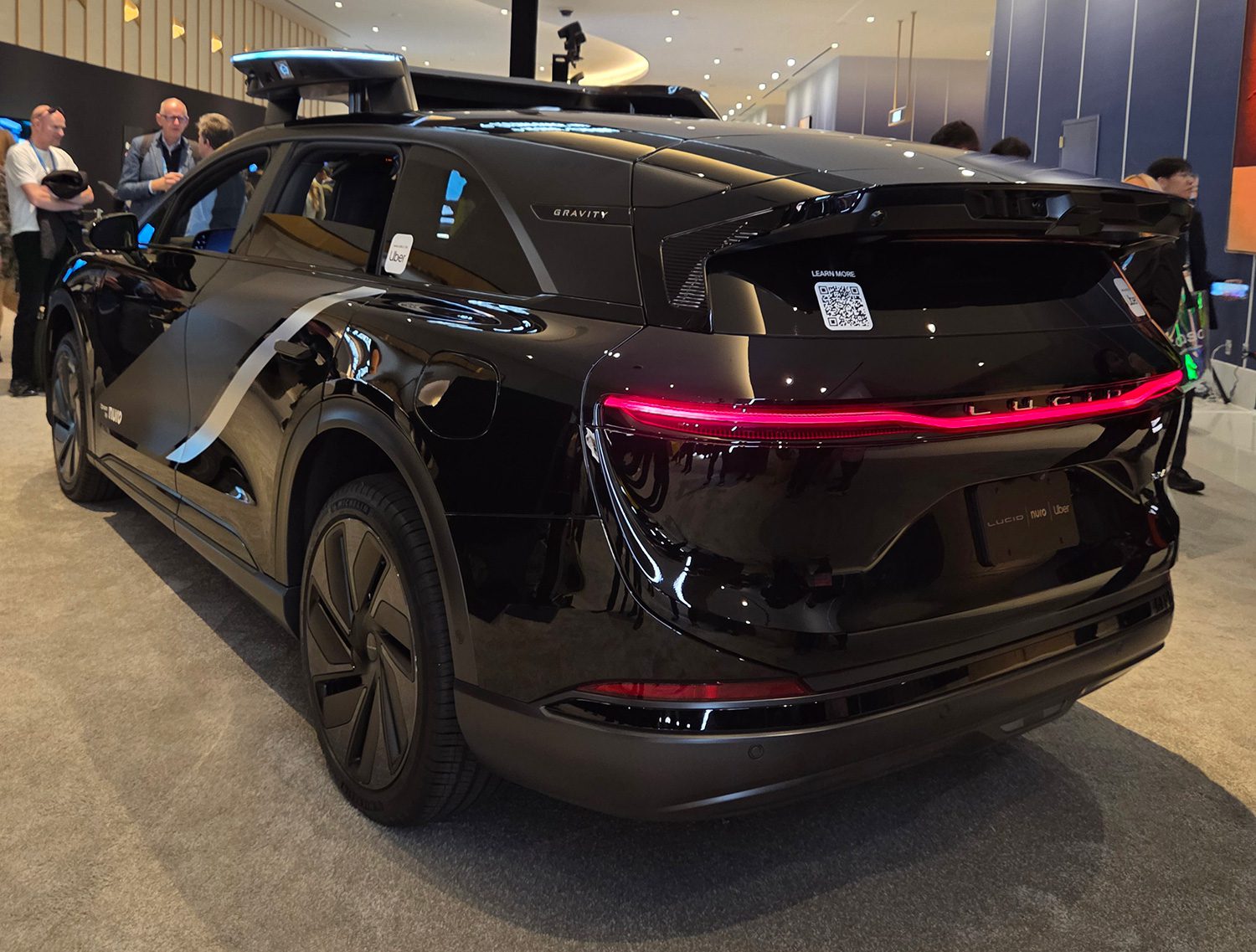
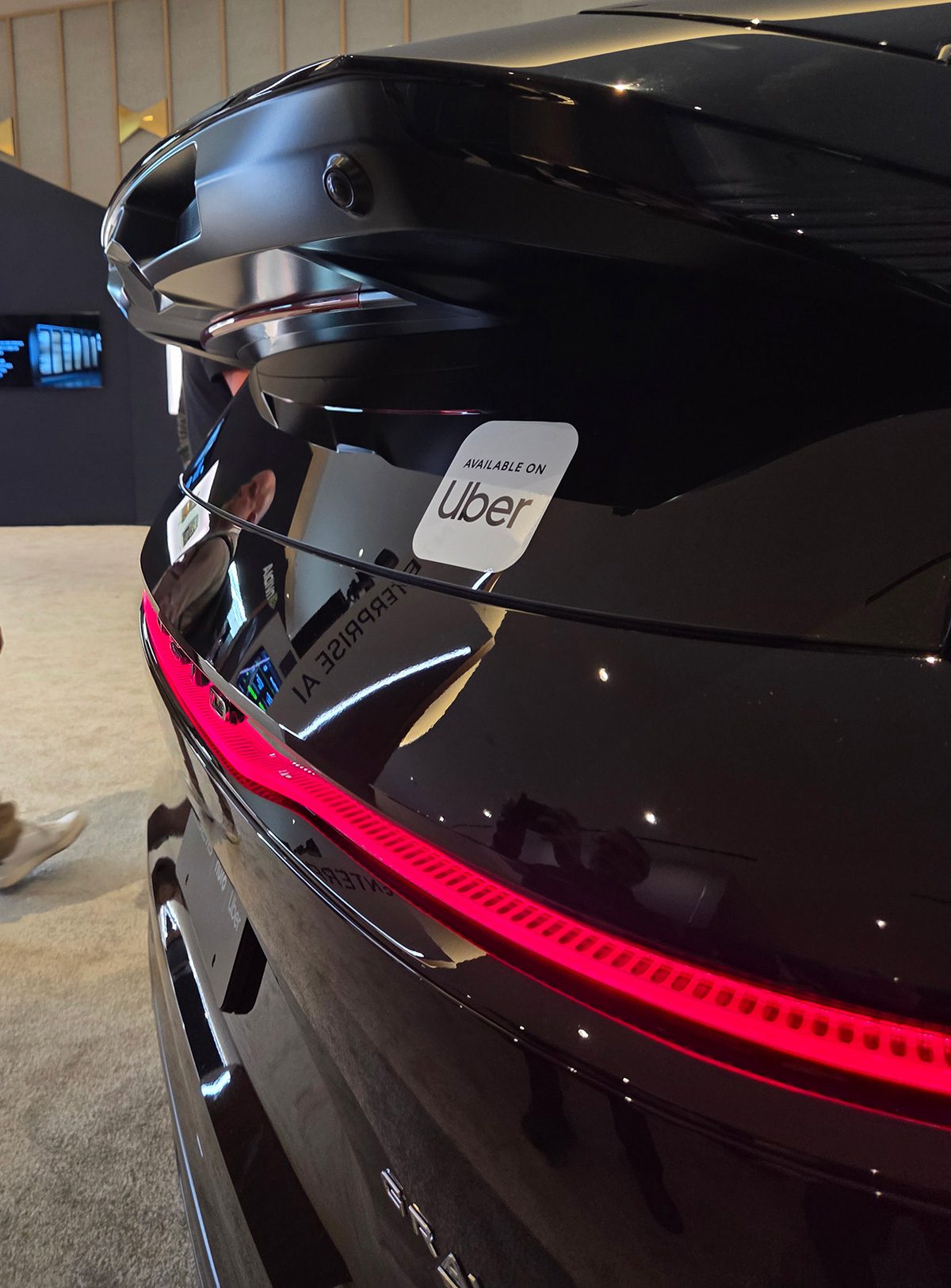
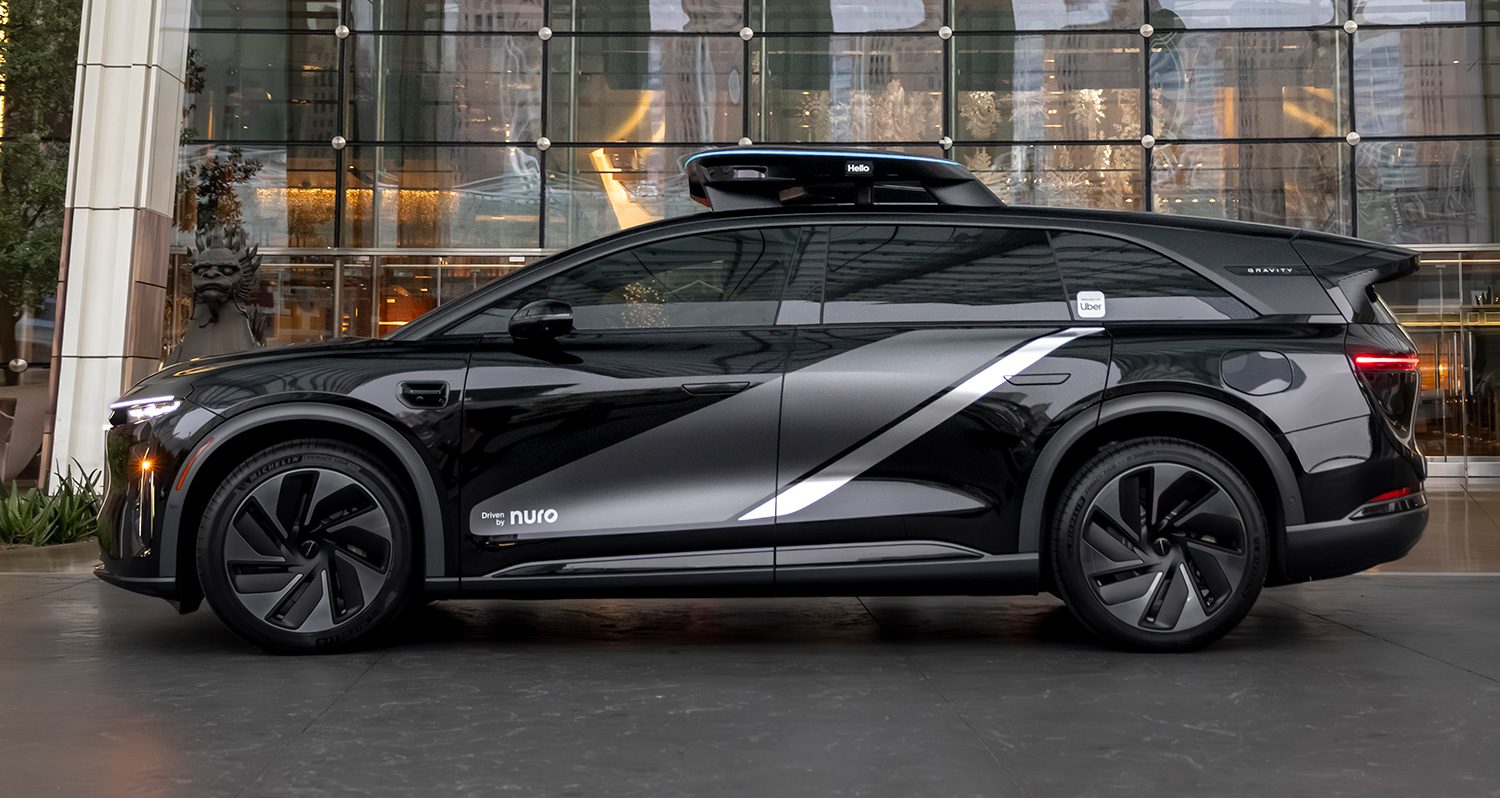
The most visible and obvious change is the “tiara” (also known as a “halo”) that holds a variety of sensors, mounted on supports above the car’s roof. It resembles nothing so much as a luggage rack, and it’s possible onlookers will read it as just that. It also contains a small LED display to help passengers identify the correct vehicle by showing their initials, along with status updates to the public while autonomous service is underway.
The tiara has by far the biggest effect on the car’s drag coefficient (Cd). The standard Gravity comes in at a remarkably low 0.24, and while Jenkins wouldn’t specify a number for the robotaxi version, he said in response to a question, “Oh, it’s more than 1 or 2 counts” (one count being 0.0001 Cd).
Neither Nuro nor Lucid cared to specify the total number of sensors (solid-state lidar; high-resolution cameras; and radar for 360-degree data). For comparison, the standard Lucid array for Dream Drive includes 14 cameras, 5 radars, and lidar, along with 12 ultrasonic sensors. Nuro suggested the actual number wouldn’t be any particular surprises to those who follow the field.
Beyond the rooftop tiara, the front apron below the Lucid “nose blade” is modified to hold more sensors than the standard Gravity, including Nuro’s solid-state lidar replacing Lucid’s hardware along with low forward-facing cameras.
Then, at the rear, the Gravity’s pronounced roof spoiler has gotten thicker to hold sensors tucked inside and underneath it. Jenkins admitted the bulkier spoiler affects rearward vision through the mirror, though the rear-view video camera will retain its full field of view. And, he pointed out, all modifications occurred in areas of the car that are black from the factory—making them visually less obvious to bystanders.

Photos by Lucid
Swapping out a software stack
The other major modification to the Gravitys, of course, is the software. Lucid’s own ADAS software, keyed to the sensors on the production Gravity, is replaced by Nuro’s autonomy stack. That code includes, Nuro said, “state-of-the-art AI [blended] with clear, verifiable safety logic.”
The partners first tested early prototypes on a closed course, as well as running hundreds of simulations, before launching on-road tests with safety drivers last December. If revenue robotaxi service starts a year later as projected, the project will have taken less than two years from announcement to realization.
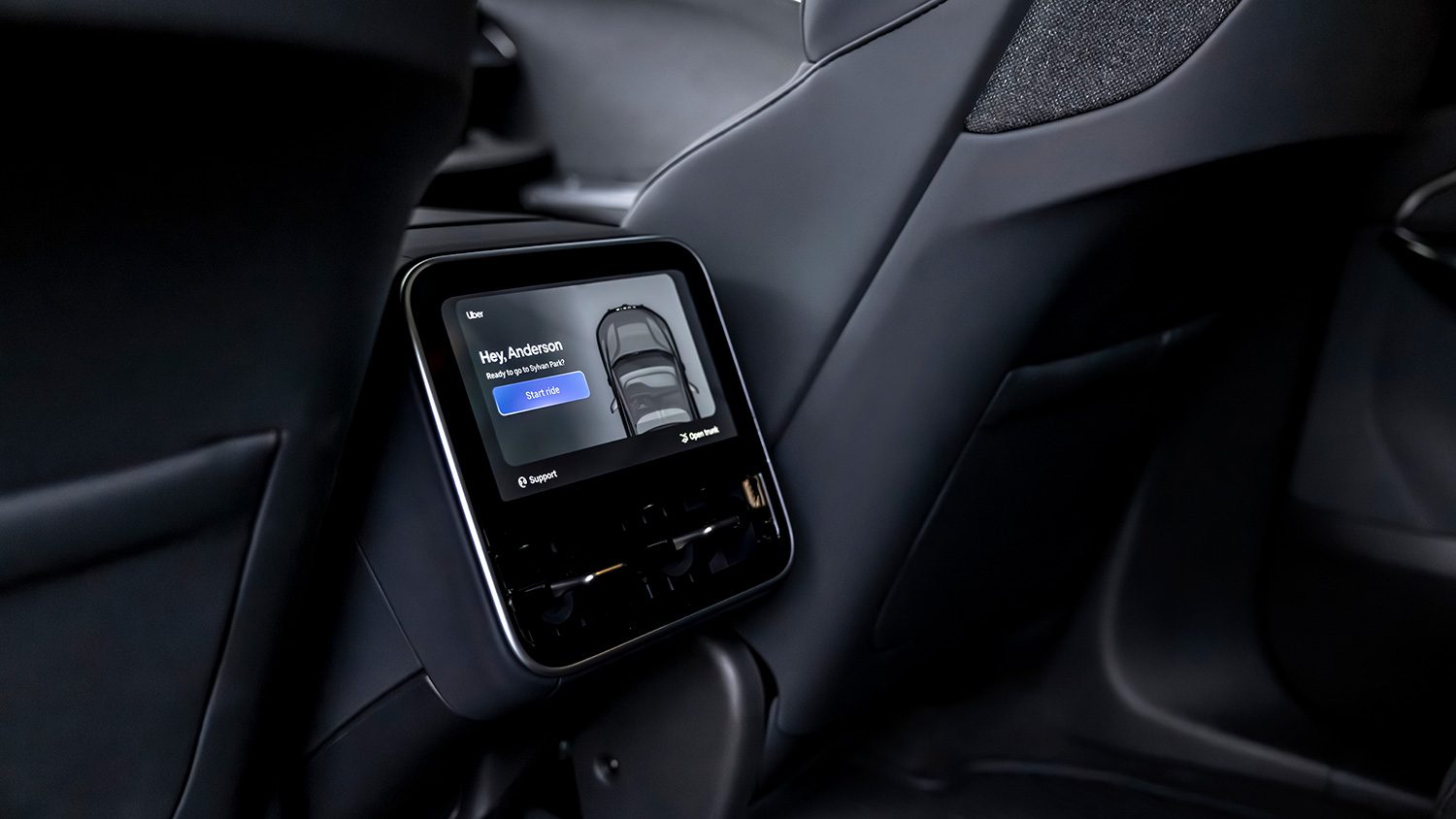
Human drivers will still able to pilot these robotaxis, Jenkins said, just like any other Gravity. But the companies likely won’t use the driver’s seat for passengers being driven autonomously. What would happen if a passenger got into the driver’s seat and attempted to drive the robotaxi? Jenkins smiled and said the company doesn’t really talk about its safety protocols—but suggested to reporters it wouldn’t be possible.
The three-way deal first came together between robot startup Nuro and ridesharing giant Uber, which had killed its own efforts to develop robotaxis after a fatal 2018 crash in Arizona. Nuro was founded in 2016 by two former Waymo engineers to develop on-road autonomous delivery robot vehicles, now in their third generation. The two companies knew each other from an early Uber Eats partnership.
David Salguero, Nuro’s communications head—who previously spent six years at Lucid—said Uber had been impressed early on with Nuro’s “safety focus and development rigor”. Further discussions ensued once Uber changed its focus and decided to partner with an autonomy company. It didn’t hurt that Uber is headquartered in San Francisco, while Nuro is less than 40 miles away in Mountain View.
Once that partnership solidified, the two companies assessed the EV landscape to choose a vehicle into which Nuro’s sensor suite and software could be implanted. Requirements included a spacious interior, high rated range, and fast recharging—each of which would make the robotaxis useful while minimizing downtime for charging.
Bay Area convenience
Geography again played a role, as Lucid’s headquarters were also in the San Francisco Bay Area, across the Bay in Newark, California. That made it possible for any or all of the partners to sit down face to face with the others as needed.
Uber chose to launch the service near home, in San Francisco. It will select future launch markets as well. It’s worth noting that Nuro is separately mapping parts of Tokyo and other areas of Japan, reflecting an investment by Toyota’s Woven Capital almost five years ago. The test cars there are right-hand-drive Toyota Priuses. The Gravity wasn’t engineered, Jenkins said, to accommodate the RHD found mostly in Japan, the United Kingdom, and Ireland.
The Lucid-Nuro announcement, however, refers to a “global robotaxi service,” suggesting future Lucid models for robotaxi service could be used in right-hand-drive markets. Execs from both companies were vague on whether the deal might be extended into the midsized lineup, though it seems logical and perhaps even likely. Test results from the Gravity fleet during 2027 and 2028 will undoubtedly be required before that decision is made.
The projected volume of 20,000 Lucids to be deployed over six years will represent just a tiny fraction of Lucid’s output within a few years, said acting CEO Marc Winterhoff. The company ultimately plans three vehicles on its smaller, less expensive midsize platform—none will be a sedan, he noted—with the first targeted for deliveries by the end of 2027.
The current year may be a major turning point for Lucid. The Gravity was slow getting into production last year, due in part to software glitches and owner howls about non-working key fobs. In 2025, Lucid built 18,378 vehicles (more than twice the previous year’s total) and delivered 15,841 of them.