




Charged EVs | Federal court upholds ioneer’s Rhyolite Ridge lithium mine permit, clearing path to construction
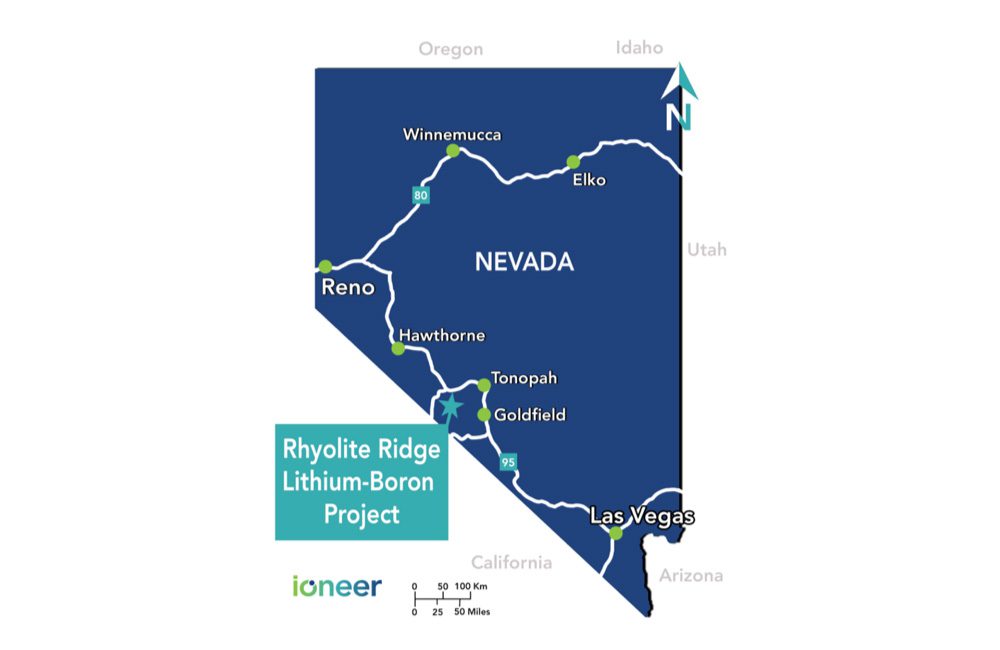
A federal judge in Nevada has upheld the Bureau of Land Management’s approval of ioneer‘s Rhyolite Ridge Lithium-Boron Project, rejecting a legal challenge that sought to block the mine over threats to an endangered wildflower. US District Judge Cristina Silva issued the ruling March 30, finding that BLM and the US Fish and Wildlife Service complied with the Endangered Species Act, the Federal Land Policy and Management Act and the National Environmental Policy Act in approving the project.
The lawsuit, filed by the Center for Biological Diversity, the Western Shoshone Defense Project and the Great Basin Resource Watch, centered on Tiehm’s buckwheat—a rare flower whose entire known population grows within roughly 10 acres inside the project area. Plaintiffs argued federal agencies failed to ensure the mine wouldn’t jeopardize the plant’s survival. Silva found that ioneer’s mitigation measures, including fencing around the habitat and buffer zones between mining operations and the buckwheat’s location, were sufficient under the ESA. The project will affect 4.9% of the plant’s 1.4-square-mile critical habitat.
Rhyolite Ridge is designed to produce 22,000 metric tonnes of battery-grade lithium carbonate per year alongside boric acid, with output projected to support lithium supply for more than 370,000 EVs annually. The project secured a $996 million DOE loan guarantee in January 2025 and holds offtake agreements with Ford Motor Company, Prime Planet Energy & Solutions (a Toyota-Panasonic joint venture) and South Korea’s EcoPro Innovation. ioneer received its final BLM permit in October 2024 after a permitting process that began in 2020. Groundwork construction is expected to start in 2026, with production targeted for 2028.
“The need for domestically sourced and processed lithium and boron has never been greater,” said James Calaway, Executive Chairman of ioneer. “The United States requires Rhyolite Ridge and more projects like it if we want to secure domestic critical mineral production.”
Patrick Donnelly of the Center for Biological Diversity called the decision “deeply disappointing,” adding that ioneer’s mitigation plan was “nothing but a house of cards that won’t save this important wildflower.” The ruling can be appealed to the Ninth Circuit.
Source: ioneer