



Charged EVs | Arteco expands low-conductivity coolant options for EV indirect cooling systems
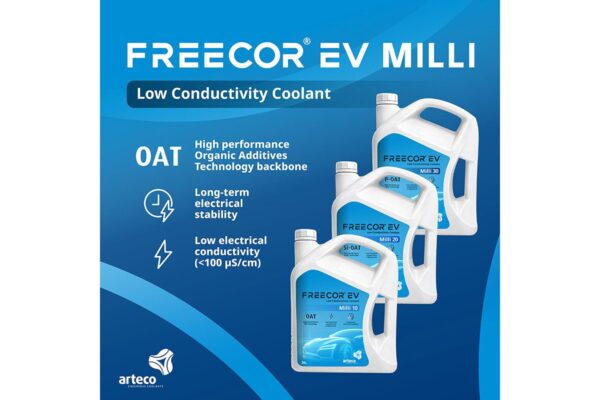
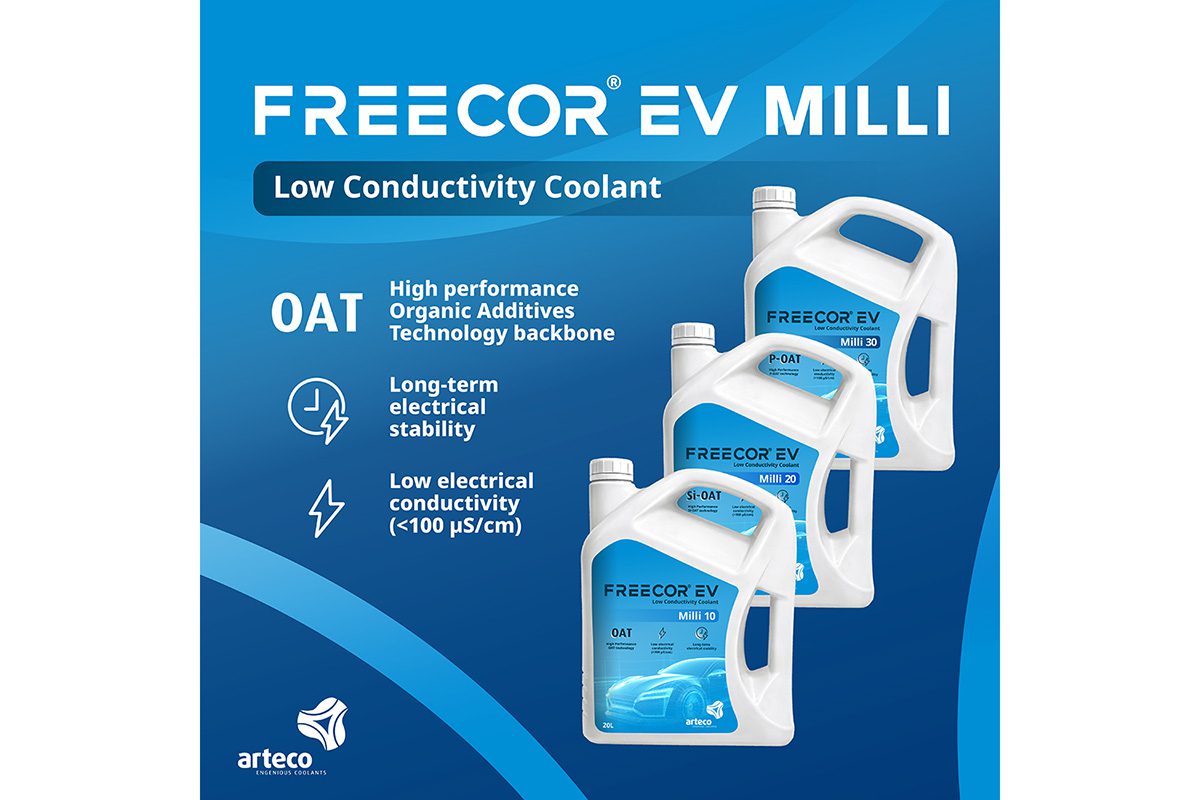
Arteco has added two patented coolants to its Freecor EV Milli range—Freecor EV Milli 20 (Si-OAT) and Freecor EV Milli 30 (P-OAT)—completing a three-product lineup of low-electrical-conductivity (LECC) formulations for indirect cooling systems in battery electric vehicles. The existing Freecor® EV Milli 10 uses standard OAT technology; the two additions bring silicate-OAT and phosphate-OAT variants.
All three are monoethylene glycol (MEG)-based and maintain electrical conductivity below 100 μS/cm, compliant with China’s GB 29743.2 standard and ASTM D8566 for low-conductivity EV coolants. They’re intended for indirect cooling of battery packs, electric motors and power electronics—the circuits where coolant leaking into a high-voltage system poses a short-circuit risk.
Low electrical conductivity is the critical property: conventional antifreeze runs at conductivities orders of magnitude higher, which is acceptable in combustion engine cooling systems but problematic near high-voltage BEV components. Keeping conductivity below 100 μS/cm limits fault current if coolant contacts live components. Beyond electrical safety, the range includes a brazing flux compensation package that protects aluminum heat exchangers from residue buildup, organic corrosion inhibition for long service life, and thermal performance Arteco says supports battery longevity and faster charging cycles.
The three OAT variants give manufacturers flexibility to match coolant chemistry to their system architecture—OAT, Si-OAT and P-OAT differ in inhibitor longevity, silicate or phosphate contributions, and interactions with aluminum components. All variants are available with bio-based or recycled base fluids under Arteco’s ECO coolant program. Freecor EV Milli 20 and 30 are now available through Arteco’s distribution network.
Source: Arteco