


Canadians Are Warming Up To Affordable Chinese EV Imports

- Over half of Canadians polled said a China-built EV wouldn’t change their buying decision.
- Canada’s new policy allows limited imports of China-made EVs with a set quota that will rise over time.
- It wants Chinese automakers to invest and build cars locally via joint ventures.
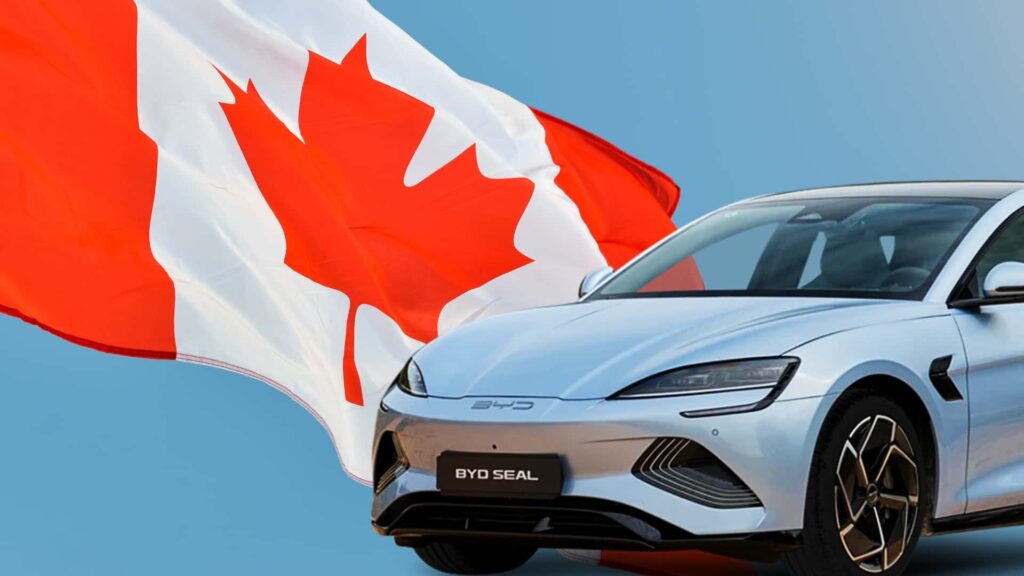
Canada has broken with the United States on its approach to imported Chinese electric vehicles, allowing up to 49,000 of them to be brought in this year at a much lower tariff rate than before. But will Canadians actually buy these cars? One recent poll seems to suggest that more people are considering it today—a sea change from even two years ago, when they were more hesitant.
A new story from Bloomberg quotes a Nanos Research Group poll of 1,009 Canadians taken in late January and early February. In that survey, 53% of respondents said it wouldn’t affect their buying decision if an EV were made in China. In fact, 15% said it would make them more likely to buy one—although 28% said this would make a sale less likely.
A similar poll from 2024 found that 61% of Canadians questioned said that they would be less likely to buy a car if it came from China, and only 9% said its Chinese origin would increase the likelihood of them making the purchase. In other words, public opinion around China’s EVs is quickly changing.
The same could be said of Canada’s policy approach to Chinese-made cars, once lockstep with the U.S. until President Donald Trump began hitting Canada with stiff tariffs and saying the country should be America’s 51st state.
Previously, Canada imposed a 100% import tariff on Chinese-made EVs, aligning itself with the U.S., but this backfired after China imposed its own retaliatory tariffs on Canadian agricultural exports (mostly canola and related products). Canada has now cut the tariff rate on Chinese EVs to 6.1%.
These new, much lower tariffs won’t mean an immediate influx of cheap Chinese EVs into Canada. At first, it will make China-built cars from familiar brands—Tesla, Volvo and Polestar, theoretically—more accessible. However, Canada’s overall goal is to boost new-car affordability. A line in the new deal between the two countries states a part of the annual quota will be reserved for vehicles costing less than $35,000 CAD ($26,000).
Canada has also reinstated its EV purchase incentive, now called the Electric Vehicle Affordability Program (EVAP). The incentive is still $5,000 CAD ($3,670) for pure EVs and $2,500 CAD ($1,835) for plug-in hybrids. The incentive is granted on a case-by-case basis based on the final purchase price of a vehicle, provided it’s less than $50,000 CAD ($36,700), and the vehicle must either be made in Canada or in countries with a free-trade agreement with Canada.
The country also aims to encourage Chinese companies to build manufacturing facilities, boosting its local automotive sector. The goal is not only to form joint ventures to build cars for the local market, but also to export them outside Canada. It’s unclear which companies the Canadian government wants to bring over.
Back in 2019, BYD opened a bus manufacturing plant in Ontario, which began building vehicles for the Toronto Transit Commission. However, it has since sold the building and is no longer making buses. According to The Globe and Mail, there was a parts supply issue for these buses, and BYD also reportedly didn’t provide sufficient engineering support to keep the fleet running. The same source suggests Chery, China’s third-largest automaker, may be the first Chinese automaker to sell cars in Canada.