



Bacteria produce a torque that can drive microscopic machines
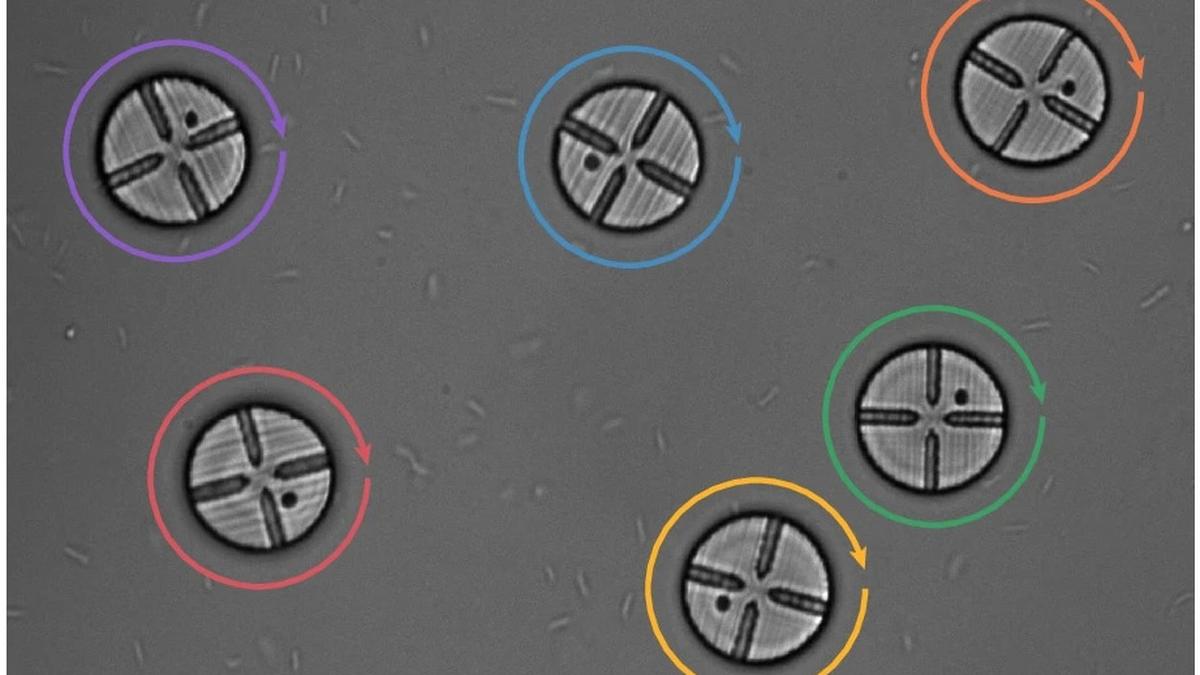
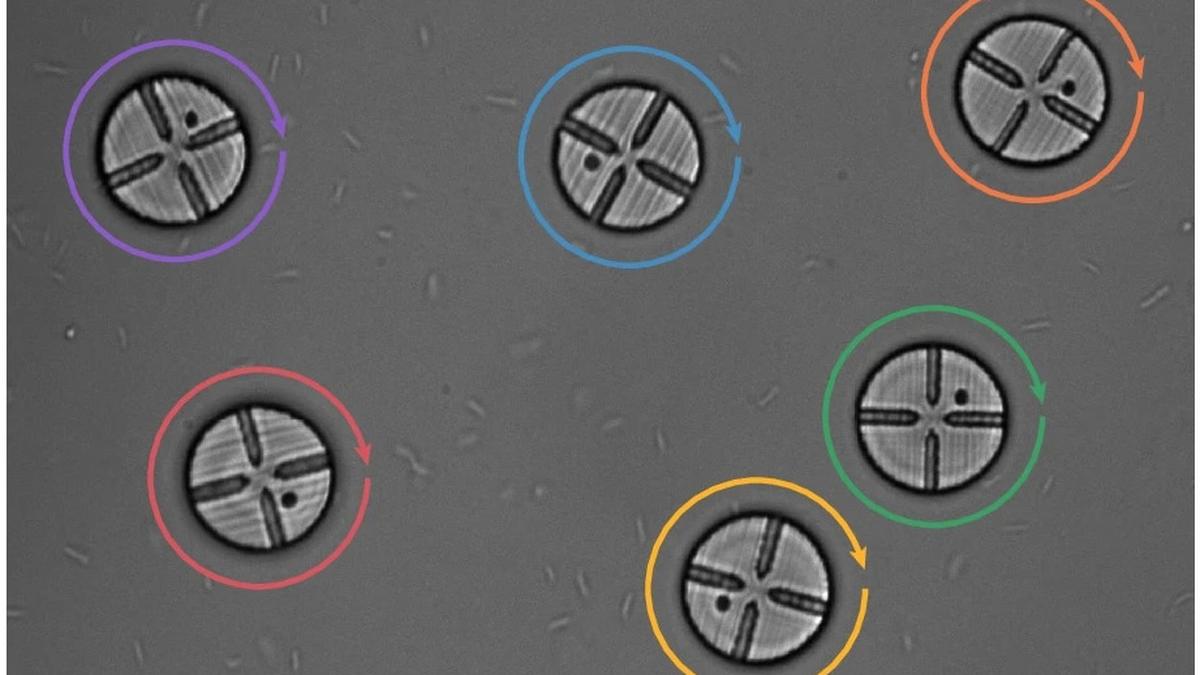
In an experiment with six pucks with narrow channels suspended in a bath of E. coli, all pucks spun clockwise. Scientists said this marks the first step towards developing ‘chiral fluids’.
| Photo Credit: Grober, D., Dhar, T., Saintillan, D. et al., Nat. Phys. (2026)
Escherichia coli bacteria are the workhorse of microbiology labs. These bacteria move through fluids by spinning their flagella — a clump of tails driven by a molecular motor in the cell walls. Because the flagella spin one way, the body spins the other to keep it from tumbling as it moves forward.
For decades, physicists described this motion using a model called the force dipole. Researchers at the Institute of Science and Technology Austria and the University of California San Diego have now found that this model is incomplete as it ignores the effects of spin. The team has shown the rotational forces bacteria generate also affects objects nearby. Their findings, published in Nature Physics, could inform the design of microscopic devices powered by living organisms.

Experiments showed that a tank full of E. coli could act like an engine. When the scientists placed two small gears in the fluid, the spinning motion of E. coli’s flagella could turn them around. But this happened only if the gears were shaped like saw blades. This was because bacteria pushing against the angled teeth would drive rotation in one direction. A perfectly symmetric disc, with no teeth to catch, would just wobble randomly.
Or would it?
The team had noticed in earlier work that perfectly symmetric objects were sometimes rotating slowly but consistently in bacterial baths. So the scientists 3D-printed symmetric discs, which they called ‘pucks’, and placed them in a liquid teeming with E. coli. Some pucks were flat circles while others had narrow internal channels just wide enough for a single bacterium to pass through. Over time, they found that the pucks with channels started to rotate clockwise.When the bacterium exited, the puck briefly spun anticlockwise.
This happened no matter which end the bacterium entered from, meaning the bacterium wasn’t just pushing against the walls. Instead, as the bacterium’s body spun, it dragged the surrounding fluid with it, creating a twisting force on the channel wall. Its flagella, spinning in the opposite direction just behind, created an opposing force. But because the body and flagella were offset by roughly the length of the bacterium, the two forces didn’t cancel each other out but produced a net torque on the disc.
Bacteria squeezing through soil or biological tissues are often in environments where this rotational effect would be significant.

Published – April 02, 2026 09:00 am IST