



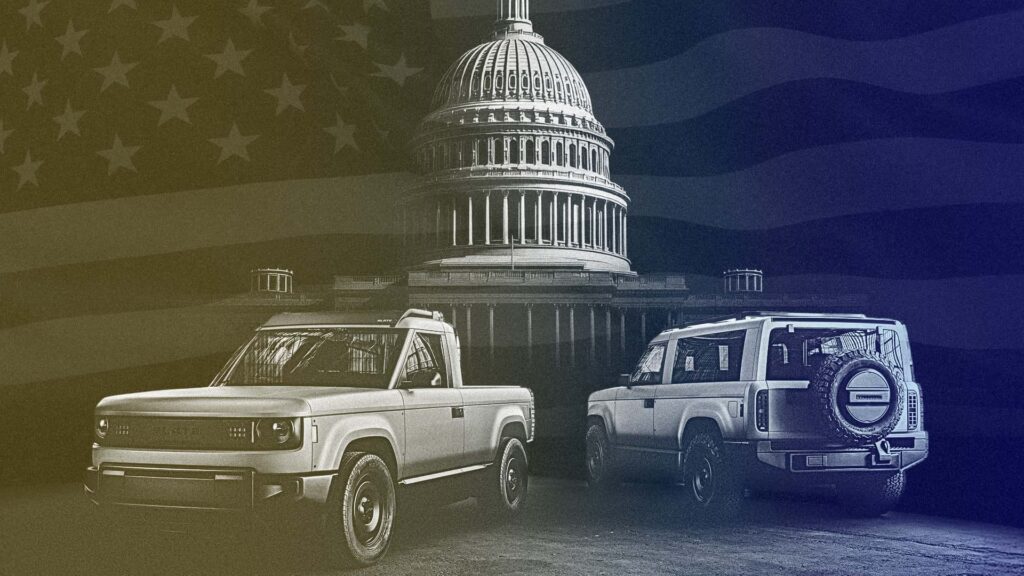
Are You Willing To Give Up Your Radio For A Cheaper EV?
- American automakers are under pressure to bring cheaper EVs to market.
- Brands like Dodge and Slate are exploring a less-for-less approach to see just how much they can strip out of a car before consumers start to care.
- How this strategy will scale long-term—especially as Chinese EVs saturate the global market—remains unclear.
There’s a new trend brewing amongst some American automakers. It’s all about flipping the Covid-era “value over volume,” high-dollar approach to manufacturing and instead focusing on making EVs cheaper.
“Cheaper” is the keyword here. Because they’re not making cars more affordable by radically rethinking battery chemistry or even focusing on new manufacturing processes like gigacasting. They’re simply paring back the feature set. They’re trying to do less so they can charge less. That means fewer buttons, fewer features, and a clear expectation conveyed to consumers that they are offering a no-frills experience on base trim vehicles.

Photo by: Slate
Leading this philosophical garage clean-out is newcomer Slate, but legacy brand Dodge is now wading into the debate, too. Both of these brands seem very interested in answering a question that no one was urgently asking: how stripped-out can you make a car before customers lose interest?
The Float
Dodge CEO Matt McAlear recently floated the idea of a back-to-basics vehicle by asking if buyers really need certain things in their car (like a radio), or creature comforts like digital gauges.
Here’s what McAlear told The Drive at the New York Auto Show recently:
I think the biggest thing that we need to start doing is challenging the industry on what the expectations are from an entry-level base vehicle. And I don’t mean that from the word cheap or less—I mean that from that of ‘back-to-the-basics.’ Analog gauges. Do you need a radio? Do you just have speakers that you Bluetooth to?
We need to push forward and maybe make people uncomfortable, but give them something they don’t realize that they want.
McAlear isn’t alone in his thinking. Slate, for example, pitched its entire existence on the same idea; a simple, stripped-down truck with limited range and a barebones exterior. Think of the Ikea-equivalent to an EV pickup, all the way down the to replacement of a radio with Bluetooth speakers.
It’s kind of cool, in theory. And for some buyers, that pitch will absolutely work. But for the price of a new vehicle? It’s difficult to justify just how many features you cut from a vehicle when you look overseas and see what China is pumping out at a fraction of a the cost.
Value, Redefined
Photo by: Slate
I want to pause here because I really, really liked the idea of Slate when it was pitched to the public. A cheap, no-frills truck that started under $20,000 when factoring in the federal $7,500 tax credit. Sure, it had roll-up windows and plastic body panels, but at a time where other automakers were focusing on pumping out electric SUVs with an average cost of $55,000, Slate’s price became super attractive for those who wanted an EV for less.
But as inflation soared and the EV tax credit disappeared, the idea of a sub-$20,000 truck went away. That meant a more expensive truck with potentially less margin to keep the brand afloat. It also put Slate in a weird position that limboed the brand between what I perceive as incredible value ($20,000) and a more questionable price point ($30,000).
When we saw that Slate in-person late September, we started asking ourselves if this is really what Americans want for the price. But I’ll admit that the folks at Slate have done a hell of a job marketing the tiny electric pickup, almost enough for me to still want one despite there being arguably better value propositions for the money coming from other automakers. The brand says it is focused on customization as a core tenet of its marketing, not just cost.
Competition Is Coming
Photo by: BYD
Where things get even more complicated is at the $30,000 price point. Ford, for example, is targeting a sub-$30,000 price point with its mystery electric pickup, which will be launch model on the company’s new Universal Electric Vehicle platform. CEO Jim Farley hasn’t mentioned stripping out basic features like power windows or the radio (yet), which could set a baseline of what Americans should expect out of a “bare bones” $30,000 EV from an established domestic automaker.
In the East, that bar is already set.
Because while American companies are trying to hit lower price points by subtracting features, Chinese automaker are doing it by reducing costs via software features, increasing scale, and leveraging vertical integration. Meanwhile, the cars are cheaper on their home turf than any Western brands.
That’s the uncomfortable contrast where we sit today. Western brands aren’t really able to deliver EVs with the features and spec people expect at a price they’ll pay right now, and are turning to drastic measures to reduce prices. Meanwhile, Chinese brands are proving that you can use scale, software-defined architectures, and battery chemistry advancements to drive down prices without skimping on features.
This is why Chinese EVs are exploding in overseas markets right now. Europe has become a hotspot for China’s exports, even despite hefty tariffs on purely electric models. Canada could soon follow as it opens its borders following a major spat with the U.S. over trade policies.
Political Fallout
Photo by: InsideEVs
President Donald Trump invited Chinese automakers to build in the U.S. earlier this year, but the offer came with plenty of requirements attached. It’s unclear if there will really be a viable path for this to happen.
Even today, legislators continue to fight to keep China’s EVs out of the States. Republican Senator Bernie Moreno said last week that he will propose legislation that would prevent Chinese cars from ever entering the U.S.
“[T]here’s never a scenario where a Chinese automobile will enter our market, that’s hardware, that’s software, that’s partnerships,” said Moreno, referring to the scope of his future proposal.
Democratic Senators are also issuing warnings related to the potential issues created if America would open its doors to China’s auto market. Minority leader Chuck Schumer’s comments noted that the temporary influx of jobs created by employing construction and factory workers would long be outweighed by the lasting job loss created by bringing the brands to the States.
From a letter penned by Democratic Senators last week:
We must be clear-eyed that inviting China’s automakers to set up shop in the United States would confer an insurmountable economic advantage impossible for American automakers to overcome, and it would trigger a national security crisis that could never be reversed.
This brings us back to the tightrope that Dodge and Slate are walking. American automakers are fighting to cut costs, as they fear competition from China on cheap EVs but can’t actually compete on manufacturing costs. That’s a function of no more subsidies for EV projects, no firmly established local supply chain for core components, less competition in the EV market, and differences in labor and land costs, among other factors. But the result is that if they want to tap the market for an affordable EV soon, they may have to do it with far more stripped-down models.
All of this is happening while the global EV market is becoming more competitive, not less. If Chinese automakers continue to deliver well-equipped, affordable EVs at sale, the “less is more” strategy might start to look like “less is less.”