




Are Western Automakers Still Cooked In the Era Of AI?
Robots. Self-Driving. “Physical AI.” Eyes-off driving. It’s a lot of tech jargon packed into a realm that most people never expected: their cars. For most, this stuff feels like some far-off future envisioned by tech bros and Wall Street guys, not something they’ll ever really have to deal with day-to-day.
But amid the last few months of news, including the headlines at CES 2026 and even some key features of the Volvo EX60’s recent debut, it’s clear that artificial intelligence is pretty much the name of the game right now. Whether it’s a hairdryer or a new car, AI is making its way into every aspect of consumer life—whether we asked for it or not.
But as fantastical as this sounds, China’s automakers are already living in that future, and now Western automakers may have yet another competitive race to join that will mean billions of dollars in investments for unclear returns.

Geely and Zeekr at CES 2026
Photo by: Patrick George
AI Comes To Automotive
This year, several auto manufacturers announced their intention to AI-ify their products. The Chinese car conglomerate Geely Auto made waves recently as company officials said it may be eyeing a U.S. expansion. But Geely’s latest products prove that its biggest focus is AI, and developing better and better advanced driving assistance systems (ADAS).
Called G-ASD, short for Geely Afari Smart Driving, this “Full Domain AI 2.0” aims to be more than just a series of buzzwords and acronyms that tell investors that Geely isn’t just a car company. Instead, Geely says this integration of AI is meant to streamline the driving experience in multiple ways, whether that’s becoming the baseline for its soon-to-be eyes-off, hands-off Level 3 ADAS assisted driving system, among other things.
Geely’s AI algorithm is developed in-house, built on the millions of data points accrued from millions of cars on Chinese roads. That AI system will be deployed across all of its lineup and brands, regardless of whether they’re EVs, extended-range EVs, plug-in hybrids or purely combustion-powered cars.
Geely insists the benefits of AI go well beyond autonomy, too. At CES, a Geely spokesperson told me that the goal is to lower energy consumption by as much as 15% because the car can “learn” from its driver and its operating environment how best to manage its power and consumption levels.
The same principle can be applied in driving in emergency situations or sporty driving, in which the car can predict sticky situations and react accordingly, like engaging all-wheel-drive quicker than normal, or using the vehicle’s air suspension to lean away from an imminent accident.
Another Geely brand, Volvo, clearly has big plans for its Google Gemini-based AI assistant in the new EX60. (Even so, Geely must keep its Chinese software walled off from its U.S.-market offerings for now, due to national security concerns.)
Photo by: Patrick George
Geely’s whole system is meant to tie every aspect of the car together with AI, to take in data from its environment and react to things in real time. Geely sees this as necessary for an autonomous future; a self-driving car needs to be able to react and maneuver in real time without human intervention.
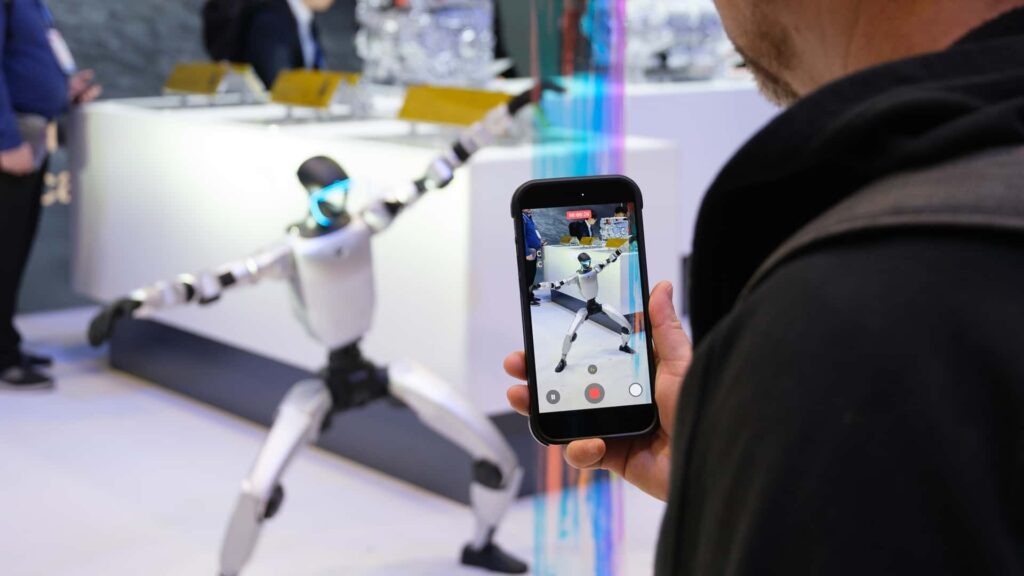
This, and those dancing robots that keep blowing up on social media, reflect the hottest new trend in tech: “physical AI,” or the emergence of all kinds of machines that go well beyond online chatbots. Robots, AI, and autonomous cars—they all converge over time using similar technology to perceive and move about the world.
Sound familiar? In November 2025, Xpeng announced its intention to push the envelope toward Level three and above assisted or full autonomous driving. Nearly verbatim, Xpeng bragged about its top-to-bottom integration of AI. It too has plans for AI to form its basis for self-driving, possibly taking a step further and claiming to use the same AI algorithm to form the logic for the way its future robot will move through the world, solving household or industrial tasks autonomously.
Photo by: Kevin Williams/InsideEVs
To be fair, it’s not a new idea. Tesla has been talking about this stuff for years, including the convergence between Full Self-Driving, AI and its planned Optimus robots. Even at this year’s CES, companies like TomTom and Mobileye have been open about their AI use to streamline the development of self-driving ADAS systems. But as per usual, it seems like China’s actually doing this stuff, and ahead of everyone else.
Like Xpeng’s desire to open-source or become a service provider for AI and ADAS services in and out of China, Geely sees itself doing the same thing in the future; offering its software to other brands around the globe that may not have the manpower or desire to craft their own AI tools.
AI itself has been a cornerstone of China’s global tech push. Whether it’s Deepseek or a car company, the country’s firms are in an arms race to build out tech. Goldman Sachs says that China’s AI companies are expected to build out $70 billion worth of investment within the next year, ranging from data centers, chips, and more. That’s “15 to 20% of what the U.S. hyperscalers are expected to spend,” the firm’s recent report said. Just by the sheer numbers, China’s dunking on the U.S.
Where Does This Race Go Next?
Photo by: Patrick George
It feels like there’s a new race ramping up here in the car world. On one hand, it seems like Western auto manufacturers (at least, some of them) are finally cracking the code on how to make an EV or PHEV that people might want to buy.
But now we’re pivoting toward something else—autonomy, and with that comes the desire for profit. It doesn’t take a rocket scientist to see that AI is part of a big push of nearly every tech company that presented at CES. Nvidia also talked about physical AI and its push to become a third-party open source service provider for AI tools. Hyundai’s partnership with Boston Dynamics brought a backlipping robot that could replace assembly line workers, while Ford showed off an AI assistant for its model lineup.
It’s not clear if there’s going to be a clear winner here. Xpeng, Tesla and Geely may be some of the first and most visible brands to venture into the car-as-AI field, but it’s clearly not the only one to do so, nor is it clear if, in the race to add AI to every tech product ever, other companies will take either company up on its offer and purchase its AI tech.
At least from a conversation I had with the VP and CTO of Geely Auto Group, Li Chuanhai, the brand doesn’t necessarily see this as a downside here. Even in China, Geely is entering an AI-focused realm with a lot of players, both from car brands and tech companies. Yet Geely doesn’tfeel that it needs to do battle intensely to stand out, because it sees AI as a core aspect of its future operations.
“Chinese automakers are very hard working, and the whole industry is aligned to focus on AI [integration] as the future of the industry,” Chuanhai said at an interview during this year’s CES. If other brands and companies don’t necessarily take Geely up on its offer, it still plans to integrate its AI tools in both its products, manufacturing and operations.
Photo by: Patrick George
When it comes to auto manufacturers in the West, it’s not clear if they’re on that level yet. There is some AI integration, like General Motors’ AI tools that helped it streamline development for the Cadillac Optiq.
But for other manufacturers, it feels like their AI integration is more akin to the hammer-in-search-of-a-nail AI integrations, like LLMs that perform party tricks. At CES, Ford gave a demonstration of the AI assistant it plans to roll out this year: a chatbot that can tell you if your Home Depot haul fits in the back of your Ford truck. That’s cool, but is that really on the same level as a saleable AI algorithm that can be used on a full line of cars, no matter the propulsion type?
That may ride on whether China’s AI systems end upimpressive when officially on the market as their PR departments and executives claim they will be. Geely and Xpeng both have timelines as to when they want to have AI features and eyes-off, hands-off driving (and Robotaxis) on Chinese roads, but we won’t know how good any of it is until it’s in the hands of the public. And in China’s case, that all depends on whether or not the government approves it. Still, at the very least, Geely’s AI-related tools may have attracted the eyes of Ford, which may be in talks to use its assets for European-market Ford products in the near future, according to recent reports.
But for now, the race between Western automakers and Chinese ones is clearly about to be more than just EVs. We’re about to see who can keep up.
Contact the author: kevin.williams@insideevs.com