



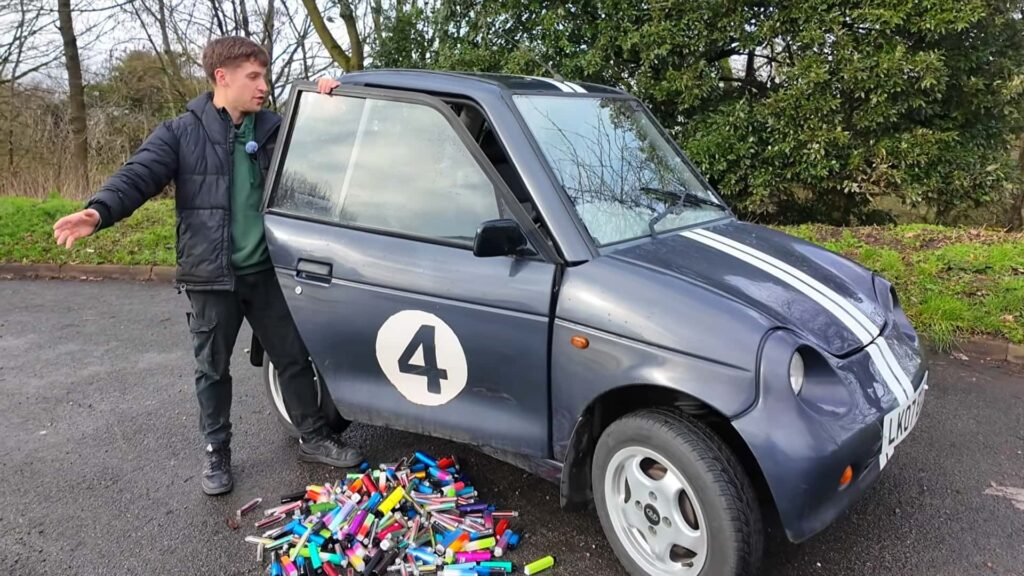
A YouTuber Made An EV Powered By 500 Vape Batteries
- Millions of single-use electronic cigarettes get thrown away, despite having a working battery inside.
- So someone decided to tear apart hundreds of vapes to extract the batteries.
- The goal: to power an electric car with disposable vape batteries.
Modern EV batteries are extremely reliable, as several studies have shown. But that was not the case 20 years ago, when EVs were little more than glorified golf carts.
Some, like Britain’s famous G-Wiz, were powered by lead-acid batteries, which were fine for the early 2000s, but they didn’t exactly stand the test of time. However, technology has advanced very quickly, and now even single-use electronic cigarettes are powered by lithium-ion batteries.
As their name suggests, these vapes are quickly thrown away, and that’s not exactly environmentally friendly. There’s a high chance that the cells inside these things are still good, so throwing them away is not very logical. And I’m not the only one saying that.

YouTuber Chris Doel set out to prove that the cells inside disposable vapes can have a second life, and that they can even power an electric car–albeit a tiny one. He sourced no fewer than 500 individual cells, tested them to make sure they were healthy, and put them together into a makeshift battery pack.
Several cells were fitted into 3D-printed enclosures that formed so-called “modular rows.” In the end, 14 rows were connected in series, creating a 50-volt, 2.5-kilowatt-hour battery pack.
That’s not a lot by modern EV standards, some of which have battery packs rated as high as 900V. But the tiny G-Wiz, which debuted in 2001, originally had a 48-volt battery pack made from 12-volt lead-acid batteries. So in theory, the new 50V pack made from vape cells should just plug in and work as intended.
To make it as safe as possible, Doel installed fuses on each cell and made good use of a battery management system that won’t allow the cells to be overcharged, thus limiting the risk of a thermal event. A bunch of temperature sensors was also thrown in for an extra layer of protection.
The end product looks quite professional, with an aluminum enclosure neatly keeping all the components safely in place. Granted, the pack is quite big, but it works, and to make matters even more interesting, it can be charged via USB-C, making it probably the world’s first USB-C-powered EV.
It’s far from perfect, though, with the biggest caveat being that the new battery pack can only output a maximum of 120 amps, while the car can request as much as 300 amps. So with the accelerator to the floor, the main breaker will interrupt power. In the real world, with a continuous draw of about 100A, the car managed to go up to around 40 miles per hour, which is not far from the original car’s 50 mph limit.
As for range, it managed 18 miles on a full charge, which is way off the 50 miles of the original car. Still, taking hundreds of battery cells out of a landfill and putting them to good use has to account for something. Plus, it looks like a really fun project.