




A hat tip to Tamil Nadu’s industrial strength, reforms
The Economic Survey of India (2025-26), while underscoring India’s strong macroeconomic fundamentals and its resilience amid geopolitical fragmentation and global economic turbulence, accords significant recognition to Tamil Nadu’s performance across a range of development indicators.
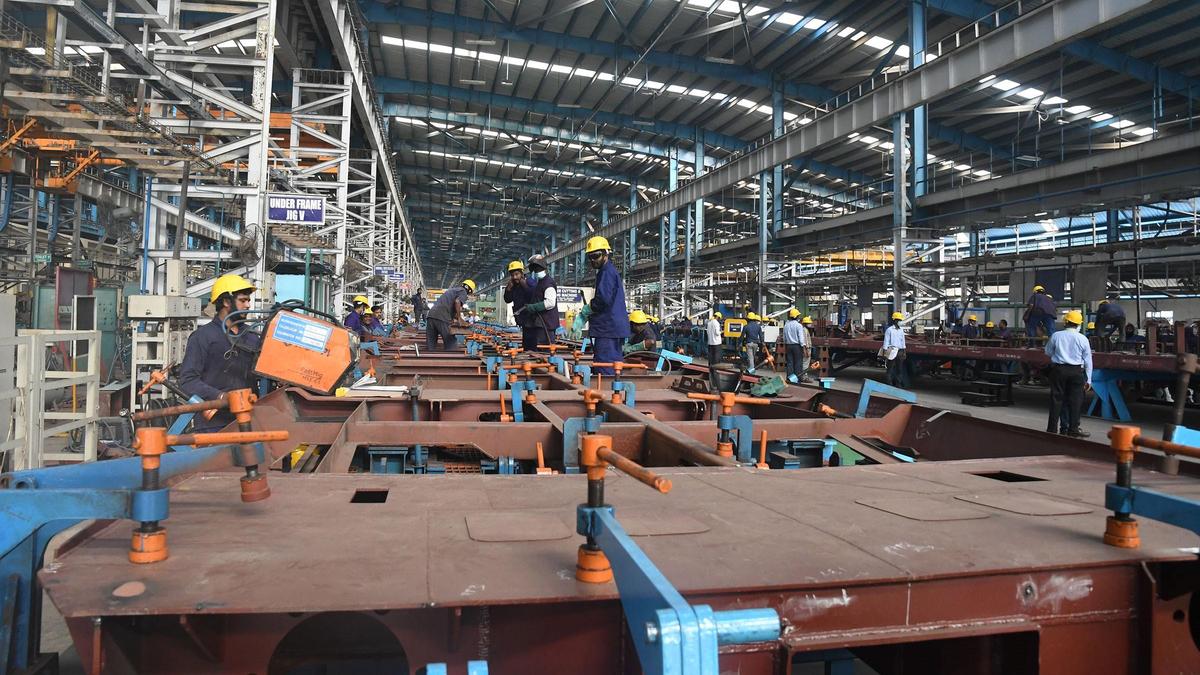
As India emerges as the fastest-growing large economy, Tamil Nadu stands out as the fastest-growing State economy, registering 11.19% real growth in 2024–25. As India’s second-largest State economy, Tamil Nadu is also a major contributor to national growth. This performance is driven primarily by the secondary sector, which grew by 13.43%. Within this, manufacturing has emerged as a key growth engine, recording 14.74% real growth — more than three times the all-India average of 4.5%. Tamil Nadu also leads every State in four-year average real manufacturing growth (2021-22 to 2024-25) at 9.38%, while its overall GSDP grew by 8.63%. Headline CPI inflation declined to 2.45% in 2025-26 (till December). The State’s merchandise exports have nearly doubled from $26.15 billion in 2020-21 to $52.07 billion in 2024-25, reflecting rising global competitiveness and industrial diversification.
The Survey makes multiple references that reinforce Tamil Nadu’s position as an investment-ready, industry-first State, highlight its strength in manufacturing employment, ecosystem-led cluster development, and also its enablement of reforms that support faster project execution and sustainable industrial growth. It also highlights achievements in urban development, skill development, higher education, agriculture and services output.
Industrial diversity
Building on its legacy in textiles and leather, Tamil Nadu has developed a diversified industrial ecosystem. The Survey cites the automobiles and auto components cluster and the electronics manufacturing ecosystem at Sriperumbudur as exemplary cases of effective industrial policy intervention. Tamil Nadu is among the few States where 85% of the cement industry is concentrated. It is also one of three States to receive final approval for financial assistance of ₹100 crore to establish a Medical Devices Park under the Scheme for Promotion of Medical Devices Parks.
According to the Survey, Tamil Nadu contributes 15% of India’s manufacturing employment — the highest among all States — surpassing Gujarat (13%), Maharashtra (13%), and Uttar Pradesh (8%). This leadership is attributed to the State’s higher concentration of large-scale manufacturing units with superior productivity, supported by infrastructure development, availability of skilled manpower and investor-friendly policies.
Under the Business Reforms Action Plan (BRAP) 2024, Tamil Nadu has enhanced ease of doing business through single-window clearances, digitised approvals and land reforms, while promoting solar parks, district-level decarbonisation plans and energy-efficiency programmes. These initiatives accelerate industrial projects while strengthening environmental compliance.
On pollution control, climate action
The Survey specifically highlights the role of the Tamil Nadu Pollution Control Board in actively monitoring industrial effluent treatment systems and supporting the establishment of common effluent treatment plants, particularly for tanneries and textile clusters. Tamil Nadu has secured a pivotal role in India’s green hydrogen economy with the designation of the V.O. Chidambaranar Port as one of only three green hydrogen hubs under the National Green Hydrogen Mission. This positions the State at the forefront of India’s target to produce five million metric tonnes of green hydrogen annually by 2030. The Chennai-Vellore-Villupuram-Chengalpattu corridor has also been identified as a potential Regional Rapid Transit System route.
The Survey takes note of the Tamil Nadu Sustainably Harnessing Ocean Resources and Blue Economy Project addressing climate vulnerabilities along the State’s 1,076-kilometre coastline across 14 coastal districts. The initiative adopts a multi-pronged approach encompassing coastal biodiversity enhancement, protection infrastructure, livelihood support, marine pollution mitigation and strengthened project management. The Climate Resilient Villages initiative is recognised as a model for institutionalising climate resilience at the grass-roots level.
It further notes that Karnataka, Maharashtra, Tamil Nadu and Telangana together account for nearly 40% of India’s services output, driven by high-productivity sectors such as IT, finance and professional services, with a strong concentration in southern urbanised States.
Tamil Nadu is also identified among high-performing States in groundnut productivity, alongside Gujarat and Karnataka, due to improved varieties, multiple crop cycles and sustained policy focus on oilseeds. Its achievements in banana cultivation are similarly recognised as region-specific success stories in horticulture.
Urban development and education
On urban development, the Survey highlights Chennai to be one of the world’s largest urban agglomerations and an example of orderly boarding and disciplined civic conduct. Chennai’s Metropolitan Area Parking Policy 2025 is cited as a national best practice, and Tamil Nadu ranks first in Civic Behaviour in the India Today Gross Domestic Behaviour Survey. The State is also among those which have liberalised building by-laws and simplified development norms.
In higher education, 17 institutions from Tamil Nadu feature in the NIRF 2025 Top 100 Overall Rankings — the highest among all States. The Tamil Nadu Working Women’s Hostels Corporation (Thozhi Hostels) is recognised as a national blueprint for enhancing women’s workforce participation. The Skill Voucher Scheme launched in 2024 by the Adi Dravidar and Tribal Welfare Department is also acknowledged for supporting students from disadvantaged communities.
Overall, the Economic Survey affirms Tamil Nadu’s development strategy to be anchored in the integration of economic growth, social equity and environmental sustainability. Industrial expansion has strengthened production, employment, technology and trade, while the State’s leadership in education, renewable energy, urban governance and social welfare positions it as a key contributor to India’s Vision 2047.
K.R. Shanmugam is Economic Consultant to the Government of Tamil Nadu
Published – February 03, 2026 12:08 am IST