




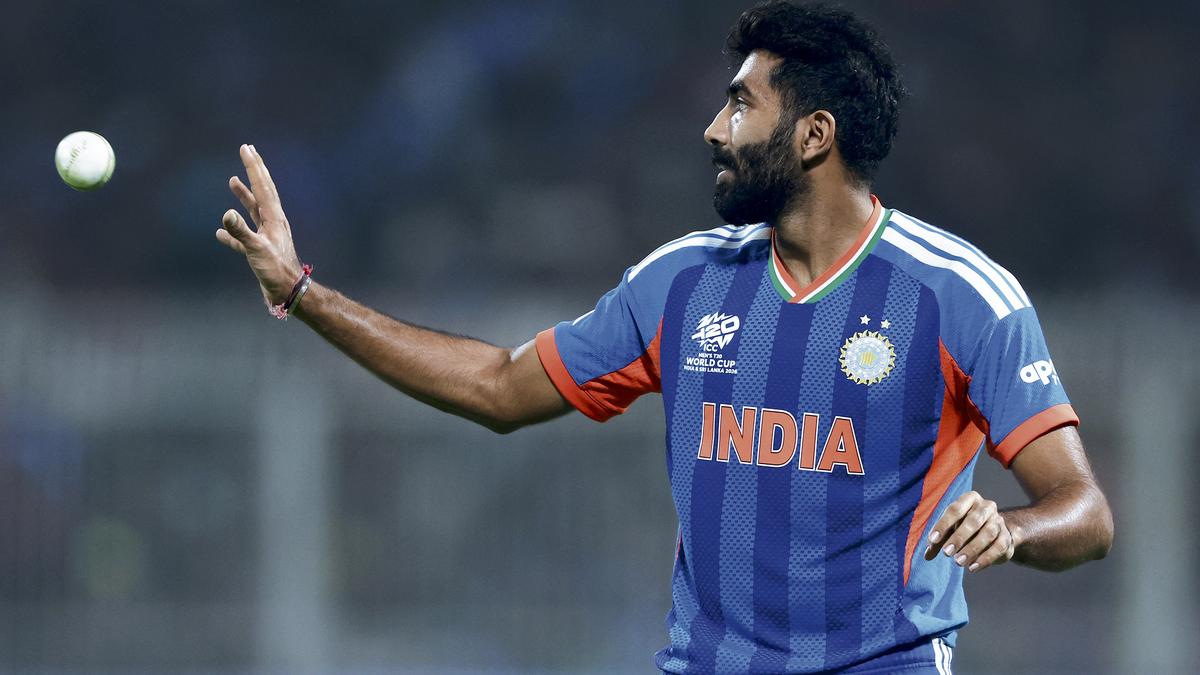
Bumrah — the pace king and the master of the slower one
Sixty-nine needed off five overs. Almost 14 an over. You’d back the bowling side nine out of ten times, especially considering that the opposition has lost five top batters, but this threatened to be the one-out-of-ten instance. Thanks to a 22-year-old who was playing the innings of his life, an innings that should serve as the springboard to greater things.
It was the second semifinal of the T20 World Cup, India against England. Or, more like, India against Jacob Bethell.
A spectacular batting display with the rejuvenated Sanju Samson leading the way had catapulted the home side to a mammoth 253 for seven, the second time in as many innings batting first that India had topped 250. Just once had a team scored more runs to win a T20I, when South Africa got the 259 needed to overcome West Indies in 2023.
Slice of magic
But Bethell was threatening to rain on India’s parade, to ruin the Indian party. The left-hander entered the fray at 38 for two after 4.1 overs, following the dismissal of Jos Buttler to two slices of Indian magic. Jasprit Bumrah, the protagonist of this piece, bowled a fabulous slower ball first up, one that completely did for Harry Brook, the England captain. Reaching out to drive, Brook found that the ball came much, much slower than he anticipated; all he did was slice it in the air, the bottom hand coming off the bat.
As the ball looped towards deep cover, Axar Patel whirled around from inside the circle, ran in pursuit of the aerial orb, his eyes trained unblinkingly on the ball coming over his shoulder. A stretch, a fall with the ball nestled firmly in his big hands, Axar had completed one of the catches of the tournament. The Wankhede Stadium erupted in delight, India heaved a sigh of relief because Brook is the kind of player that can single-handedly influence the outcome of a contest, like he had done a week or so previously against Pakistan in Sri Lanka.
Bethell came in with a clear game plan – take the fight to the bowlers, not allow them to settle down. He backed away to his second ball from Bumrah, who followed him, targeting his pads. The left-hander was up to the task, swinging the ball to long-leg for six. A glorious shot, if ever there was one. Then came a stunning assault against Varun Chakaravarthy, then the No. 1 T20I bowler in the world. A pull over long-on, a drive over long-off, a reverse swat over deep-point – three balls, three sixes, the Chakaravarthy threat dismantled.
By now, Bethell was flying. His first 13 deliveries brought him fives sixes and a four – he was 39 off 14 and continuing to tee off, making the Wankhede looking singularly tiny. With Will Jacks and then Sam Curran, he drove daggers of dread into Indian supporters; hardly an over went by when a boundary wasn’t struck and by the start of the final chunk of five overs, every mouth was dry, every set of lips had a prayer, every heart was thudding. The game was slipping away.
Like Rohit Sharma had done in the 2024 final when, again, the game was slipping away, Suryakumar Yadav brought back his bank. The one bowler in the world capable of putting a brake on the scoring. India needed control; ideally a wicket, that of Bethell’s, but control would do, too. In 2024, with South Africa requiring 30 off 30, Rohit turned to Bumrah, who produced a spell of 2-0-6-1, breaking the momentum and setting up a seven-run win. Normally, Rohit would have used Bumrah in overs 17 and 19 but he was compelled to employ him at 16 and 18 because otherwise, it would have been too late. Suryakumar, cut from the Rohit cloth and unabashedly using Rohit as his role model, did likewise, not in hope but in conviction.
Extraordinary stuff
Bumrah didn’t disappoint. He doesn’t, you know. Curran whipped a rare full ball on his pads through square-leg for four in the 16th over, but it was Bumrah’s sole indiscretion in 12 high-pressure balls, with the stakes so high and the game literally in his hands. Other than that, Bumrah conceded 10 in 11 deliveries. By the time he was done for the night, having nailed a succession of yorkers in his final over, Bumrah had extraordinary figures of 4-0-33-1. And taken the equation to 39 off 12 balls. England fell seven short, another eerie coincidence to the 2024 final when South Africa too went down by seven runs. The common thread – Bumrah, with support from Arshdeep Singh and Hardik Pandya.
After the last ball of his evening went to the deep field on the on-side for a single, Bumrah stood in his followthrough. Crouched. His hands on his knees. Spent, drained, knackered. Under pressure, oh, under extraordinary pressure, he had again come up trumps. 8.25 runs an over in a game that produced 499 runs in 40 overs. Tilting the advantage decisively India’s way, when Bethell was on the cusp of producing the most special effort of the tournament, if not of World Cup history. Some men aren’t measured by wickets, some efforts aren’t judged by how impressive the ‘W’ column is. This was one of those.
But, as we have said numerous times, cricket is a numbers game. Economy is fine, but where are the wickets? What is your strike-rate? These are inevitable questions from those statistically minded, and who see the world in black and white, ignoring the grey shades that make it interesting, compelling, gripping. For them too, Bumrah had an answer, three nights later at what once was India’s theatre of nightmares but which they have since transformed to a stage of dreams realised, of a mission accomplished.
Batting firepower
Like against England, India again put on a batting display so commanding in the final at the Narendra Modi Stadium that you wondered how this line-up hadn’t done more in the group stages. Once more, Samson was the leader, but there was fabulous hands from Abhishek Sharma, until then unrecognisable as the all-conquering force of the previous year, and Ishan Kishan, making the most of his second coming. This time too, India powered past 250, ending on 255 for five when they ran out of time. Would New Zealand do an England? Who would be their Bethell? Would it be Finn Allen, who smacked a 33-ball century in the semifinal drubbing of South Africa? Or Tim Seifert, the other right-hander who, alongside Allen, had realised 463 runs, the most by an opening pair in any World Cup?
Axar settled Indian nerves by having Allen caught at long-on in the third over, the cue for Bumrah to mark his walk/run-up. In the previous over from the same end, Pandya had been clubbed for 21; now, the onus was on Bumrah to build on the gains accrued from Axar’s strike.
Clueless Rachin
Like against England, Bumrah produced a devilish off-pace ball. With many bowlers – make that most – there is some indication of what is to come. A drop of the front shoulder, a last-minute adjustment of the seam position, something, anything. With Bumrah, there are no cues. No perceptible changes. No hint of what the ball leaving his hyperextended right arm is likely to do. Rachin Ravindra was as clueless as Brook had been; the left-hander was lulled into playing the flick early and in the air. A full-pace ball might have soared over deep backward square, but this one had more elevation than distance. Unlike Axar who ran back, Kishan ran in, focused and committed, tumbled forward, saw the ball bob out of his hands and was still alert and calm enough to grab it on the second try. First strike to Bumrah.
By the time Bumrah came back on for his second spell (his first read 2-0-9-1), the game was done and dusted. New Zealand were 139 for six after 15, needing 117 in 30 deliveries. Impossible at the best of times. With Bumrah around, hmmm…
Until that point, Bumrah had 11 wickets for the tournament. Impressive, but there were so many ahead of him – Chakaravarthy (14). A trio with 13 each. Another pair with 12 apiece. And five more who also had 11. Maybe Bumrah didn’t know, maybe he didn’t care. But he felt the need for one signature performance, one final stamp of authority, and when Bumrah feels the need, you know what happens.
Three slower deliveries, three wickets in seven balls, three times the stumps and bails lighting up. For the first time in his career, Bumrah had a T20I four-wicket haul. Maybe he himself was surprised at being named the Player of the Match – which should have been his by right in the semis – but he wasn’t complaining now, was he?
For those who love quantifying things, Bumrah’s World Cup read thus: eight matches, 168 balls (28 overs), 174 runs conceded. A joint tournament-high 14 wickets, economy 6.21, strike-rate 12 (two overs per wicket). Among the dozen bowlers with more than 10 wickets, only Shadley van Schalkwyk, the American who finished with 13 sticks, boasted an economy of under 7 (6.80), but he also conceded more than half a run an over compared to Bumrah. Van Schalkwyk bowled on reasonably bowler-friendly strips; Bumrah’s last four matches were on wonderful batting surfaces, where he took seven for 105 from 16 overs. As the tournament progressed, Bumrah got better and better, the sequence beginning in India’s first Super Eight loss to South Africa. The Proteas posted 187 for seven, Bumrah finished with a surreal three for 15. Madness.
India used Bumrah judiciously between the two T20 World Cups. He didn’t figure in a single ODI and played only 17 of 42 T20Is. That shows in what esteem the think-tank holds him, how crucial they believe he is to the team’s fortunes. It’s impossible to imagine what it must be like to carry so many expectations every time he has the ball in his hand; only Sachin Tendulkar has been burdened with crazier expectations. To Bumrah’s credit, he has managed to distance himself from the ‘outside noise’, retain his focus and concentrate on what is in his control. That’s not a bad philosophy when it brings you 14 wickets in eight outings, a Player of the Final honour and a second straight World Cup winner’s medal. Take a bow, Jasprit Bumrah. And keep at it.