




Holding up half the sky on India’s farms
As we celebrated Women’s Day on March 8 this year, we also celebrated the International Year of the Woman Farmer (announced by the United Nations Food and Agriculture Organization). It was an opportunity to recognise the contribution of working women to India’s agricultural economy. As official statistics do not give a complete picture of the scale of participation, type of work, and economic contribution of women, it is field data that we must turn to. It tells us that while women’s labour is central to crop and livestock production, the remuneration to women workers is extremely low and stagnating.
Counting women workers
First and foremost, we lack accurate information on how many women are actually engaged in agriculture, livestock rearing, fisheries and other allied activities. Large-scale labour force surveys (such as the Periodic Labour Force Surveys) are unable to capture women workers accurately because in a largely informal agrarian economy, women’s work is often home- or farm-based, unpaid, seasonal, intermittent (even over the course of a single day), and intermingled with care work. For example, a woman respondent may not report herself as a “worker” if her day involves multiple tasks of child care interspersed with animal rearing.
What official labour force surveys tell us is that women’s work participation in rural India has risen sharply in recent years. Among rural girls and women aged 15 years and above, 46.5% were in the workforce in 2023-24 as compared to 35% in 2011-12. This still remains lower than the rest of the world: according to the International Labour Office, women’s work participation was in the range 57%-63% in a majority of countries.
Hidden behind this statistic that shows a rise in rural women workers lies a less happy reality, namely, that the rise is largely in the count of ‘self-employed’ women, reflecting a lack of wage employment opportunities. In 2011-12, 60% of rural women workers were classified as self-employed; the proportion rose to 73 per cent in 2023–24. In the same period, the share of women employed as regular and casual wage workers fell. Further, the share of self-employed women working in the agricultural sector rose from 48% to 62%, and, of the total number of self-employed workers in agriculture, women comprised almost one-half (47.2%in 2023-24).
Put together, in 2023-24, there were at least 117.6 million women working in agriculture (of whom 21.7 million were hired workers, 95.1 million were self-employed and 0.8 million were regular workers). The estimated male workforce in agriculture was 127.5 million.
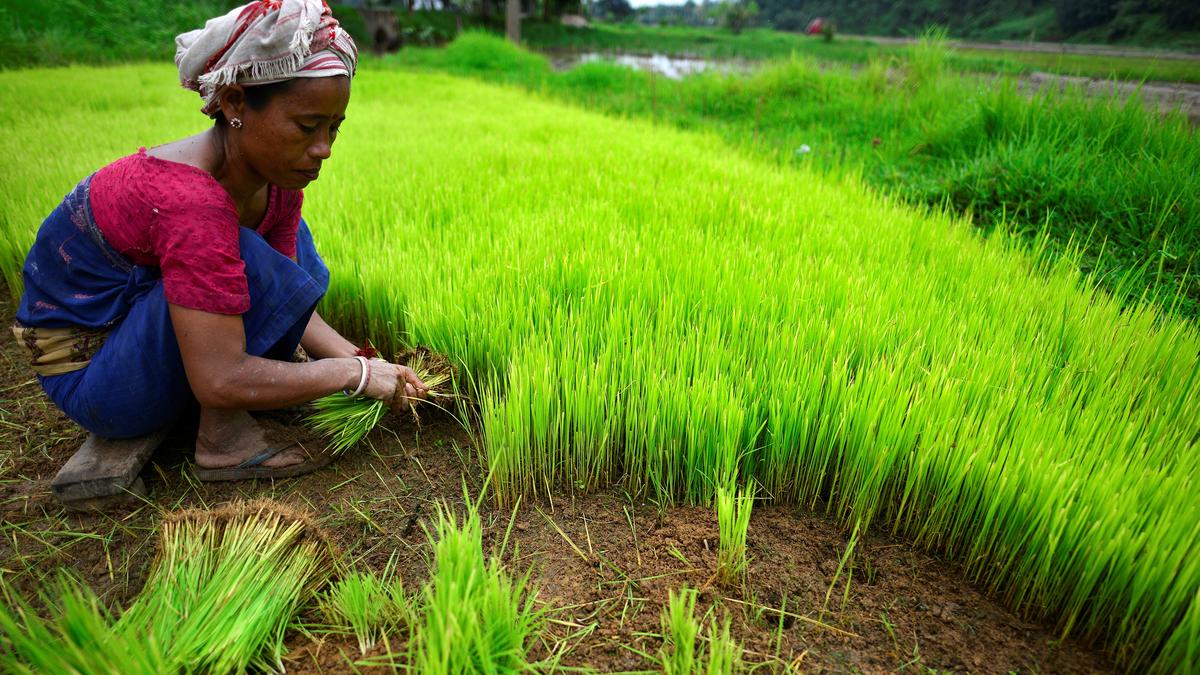
The first sector we consider is crop production. Official statistics cannot tell us the share of women workers in total labour deployed in crop cultivation as gender-disaggregated data on family labour are not collected. We provide an answer with data from village-level surveys conducted by the PARI project of the Foundation for Agrarian Studies (www.fas.org.in/pari). From this unique database of 27 villages, we draw on two villages, Palakurichi and Venmani, from Nagapattinam district of Tamil Nadu (studied in 2019) and two villages (Harveli and Mahatwar) from western and eastern Uttar Pradesh (studied in 2023).
As a socio-economic classification of households in these villages is available, we focus on the peasantry and manual worker households, who constitute the majority. We have excluded landlord or capitalist farmer households, and those engaged in business or salaried employment.
In the four selected villages, women accounted for about one-third of family labour (except the village in western Uttar Pradesh where it was lower). When family and hired labour are combined, women accounted for the major share in Palakurichi (61%) and Venmani (57%) in Tamil Nadu, and about 41% in Mahatwar village of eastern Uttar Pradesh. These differences arose on account of several factors including crop choice and farming systems, and the socio-economic composition of households. Nevertheless, the key message is that crop cultivation relies heavily on women’s labour.
The second sector is livestock rearing, one of the fastest growing sectors within agriculture, and where women constitute the primary work force. The PARI village studies show that in family-based livestock rearing (particularly milch cattle and poultry), most tasks are performed by women. If a household owned cattle, inevitably a woman participated in livestock labour, spending about 2 hours for every animal reared. At last count, 40 million rural households owned milch animals (All India Debt and Investment Survey, 2018-19), suggesting that around 40 million women were engaged in animal rearing.
The third sector is wage labour. As mechanisation has progressed and aggregate demand for labour in agriculture has declined, so has the demand for women’s labour. Our estimates show that the share of women workers in total casual labour employment in crop production ranged from 16% to 71% across the four villages, but was more than one-third in all but the western U.P. village (where labour hiring is more complex given the scale of sugarcane cultivation). And, these women hired workers belonged not only to manual labour households but also to the lower rungs of the peasantry.
Earnings and wages
For a workforce of more than 100 million, the question of remuneration is clearly important. What is the level of explicit or implicit earnings obtained by a woman worker in agriculture today?
For wage workers, the prevailing wage rate is observable. At today’s prices, a woman worker in agriculture earned less than ₹300 a day in all four villages. The gender gap in wages was higher in those regions with overall higher wage levels. Women’s wages (₹290) were less than 50% of male wages in the two villages of Tamil Nadu; in the two villages of Uttar Pradesh, women’s wages were lower (₹242-₹276) but so were men’s wages and the gender gap was narrower.
Official statistics reveal a similar story. In November 2025, according to the Labour Bureau, the average all-India daily wage for agricultural work (sowing/transplanting/weeding) for a woman was ₹384. There were, of course, variations across States, with women workers in Kerala receiving the highest daily wage (₹646). Furthermore, data show that wages corrected for inflation have barely risen over the last decade.
There are no official data on women’s earnings in livestock earnings, and we estimated the implicit daily earning, based on income generated from animals over the year (based on production of milk, dung) and total hours of work. In the two U.P. villages, where milch animals were widely held, the implicit daily earning was around ₹100. In short, women earned only two-fifths of the prevailing agricultural wage rate for their labour in cattle rearing.

Turning to crop production, it is difficult to estimate earnings per worker, as many members of a family may contribute to production. Suffice to note that in all four study villages, the return from crop production was low, averaging less than ₹16,000 a year in the eastern U.P. village and less than ₹24,000 in Palakurichi, the Tamil Nadu village. Even if half the income was apportioned to women, their incomes would not be high.
The picture so far
It is clear that women now constitute about one-half of the agricultural workforce in India (the actual number is likely to be higher for the reasons mentioned above). The majority of rural women were self-employed workers, but only 10% of rural women owned land, the primary asset for a cultivator. Turning to agricultural workers, women workers now (21.7 million) exceed the number of male workers (19.7 million), a first-time occurrence in post-Independence India, but wage rates for women are low in absolute terms, with a few exceptions, and reveal a large gender wage gap.
Women workers hold up half the sky in rural India. The Indian state has failed to correctly record the number of women workers, and to ensure that they receive decent wages and all rights as workers.
Women sustain India’s farming economy but remain underpaid and undercounted
Madhura Swaminathan is former Professor, Indian Statistical Institute. Arindam Das is Joint Director, Foundation for Agrarian Studies