





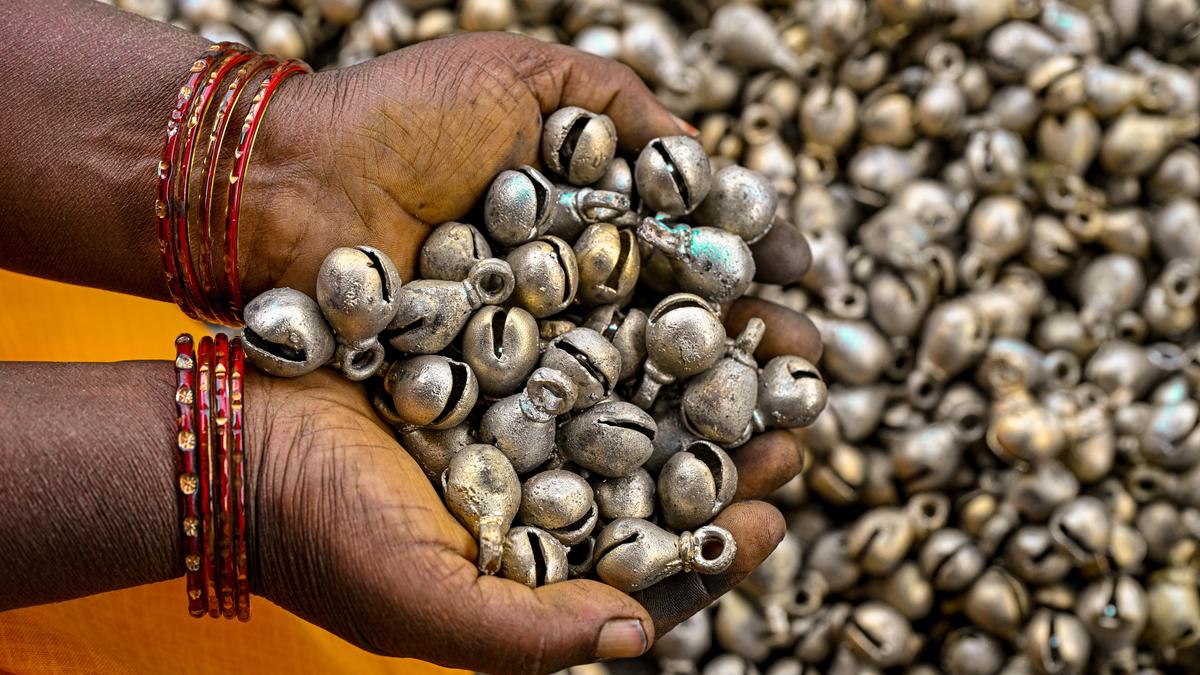
How the forges of Venkatanayakanpatti keep bells tinkling
Shankar and his family members are seated on the floor outside their home, building up a mound of what looks like chocolate truffle balls when we meet at Venkatanayakanpatti village, on a hot day.
Weighing approximately 65 grams, each of these balls hold within, the mould that will eventually create the brass bells that provide the soundtrack to many different lives.
Whether stitched onto felt strips and worn by dancers as ‘salangai’ or ‘ghungroo’ to unite rhythm with beat, or as adornments on domesticated animals especially in rural sports such as ‘jallikattu’, these handmade bells, with their distinctive ‘jal-jal’ sound, have a humble start from home-based smithies such as those in Venkatanayakanpatti, situated 56 km from Tiruchi.
“There are at least 35 steps in manufacturing a ‘mani’ (bell), and this is just the first one,” says Shankar, as his fingers ceaselessly shape balls from a lump of clayey paste made with moist riverbed soil and a mixture of natural resins.
Manual manufacture
The small balls are dipped in melted beeswax and castor oil and then further coated in another clay paste. Hooks are shaped with the same moulding mixture and attached separately to each bell.
The completed bell casings are baked in batches of 24 or 36, set in handmade moulds that have an inlet for the molten metal and an outlet for the melted wax.
Once out of the kiln, the moulds are broken open and each bell is retrieved from its earthen womb carefully.
Shankar’s wife Rasammal extracts the hollow brass balls from the baked mould with the help of a small hammer. She uses the tool to pry open the ball, neatly taps out the burned mud inside, while inserting smaller steel balls that make the bells tinkle.
The burned mud is reused for other processes in the smithy.
A deburring machine is switched on inside, as Shankar’s eldest son, a welder who has been initiated into the family profession, removes the rough edges from each bell.
In another part of the colony, Lakshmi coils malleable moulding paste around a thin metal rod to form hooks. Once done, she cuts through the coil with a razor blade, and carefully unwraps the little hooks, throwing them into a plastic tub nearby.
Her daughter-in-law Parvathi takes each paste hook apart and fixes them to the bell moulds.
“Sunlight is our friend. We cannot dry the clay balls during rainy weather. It takes at least two weeks for the bell makers to get a batch of 200 to 300 kilos of bells ready for the kiln,” says Azhagar Kumar, a fifth generation bell maker.
The entirely manual process is fascinating to watch as mud leads to metal and takes shape through what appears to be a complicated system of calculations.
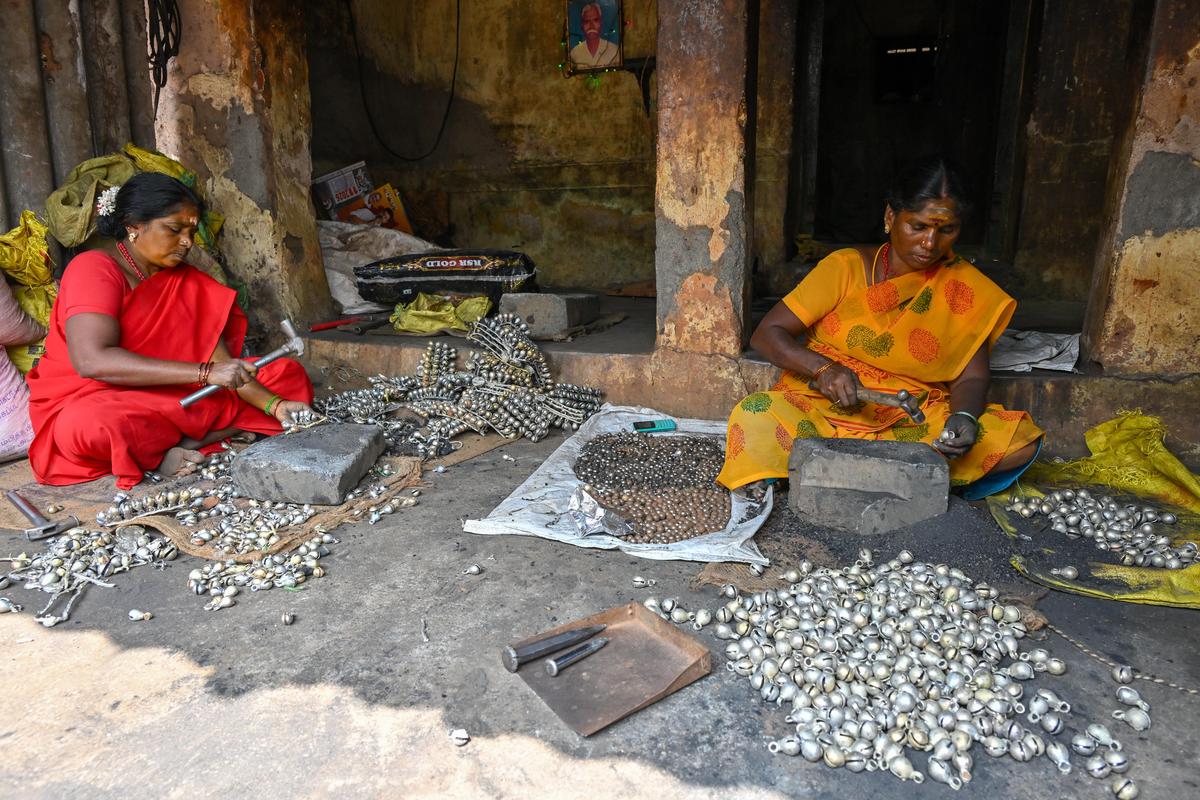
Women artisans Parvathi and Ponnammal at work making brass bells at Venkatanayakanpatti.
| Photo Credit:
R VENGADESH
Legacy craft
“We usually buy our raw materials from Madurai, depending on the size of our orders. The costliest of these, is the pithalai (brass), which is selling upwards of ₹600 per kg these days,” says Shankar.
Small bell manufacturers rely on metal scrap dealers for their stock. Quite often, old gas stove burners, taps, door locks and other decommissioned daily use brass objects find their way to Venkatanayakanpatti’s bell forges.
The bell makers are booked with orders throughout the year, from customers in Tiruchi, Pudukottai and Madurai seeking them out regularly for Pongal, Jallikattu, and folk festivals where processional dancers and silambam performers adorn themselves with bells.
These artisans are among the guardians of Tamil Nadu’s legacy of ‘lost wax casting’, or cire perdue, a metalworking technique that can be traced back to the Harappan civilisation.
Also known as ‘investment casting,’ the technique involves the creation of a detailed mould in wax, into which molten metal is poured. The heat of the liquid metal melts the wax, but leaves behind a precise replica in the resulting cavity.
“There are two types of lost wax casting: the solid and the hollow. Solid casting is primarily used in South India, especially in places like Swamimalai, to create bronze idols from a wax model; while in the hollow method, a thin and empty wax shell rather than a solid model is used to manufacture lighter brass, or bronze items such as figurines, bells, and containers by tribal communities. Every piece is unique, because the moulds are broken each time these artefacts are created,” says J Raja Mohamed, former curator of Pudukottai Government Museum.
Dwindling numbers
Venkatanayakanpatti once used to have over 20 family-run smithies supplying all types of metal goods to order. The number has slowly decreased to approximately five manufacturing units due to inflationary costs.
“We have to spend around ₹12,000 to buy the raw material (excluding brass) for an order. We can earn most of it back, but the profits are not cost-effective, because once you pay out the overheads, including salaries, we can save only enough to invest in raw materials for the next order,” says Kumar.
Ponnammal has her hands full with cleaning bells, as she also keeps a close eye on rice being cooked for lunch.
“The Tamil month of Thai is very busy for us, as bells are in great demand to dress up livestock during festivals. Besides this, we also make bells for silambam, and temple bells which weigh anywhere from five kilos to 50 kilos,” she says.
The craftsmanship of these artisans remains in great demand. “When my grandfather started out, customers used to come from nearby villages. In my father’s time, they came from Tiruchi. Now in my time, they are being exported to foreign countries by resellers. This is a traditional craft, and I am hopeful that our children will take it up after us,” says Shankar.
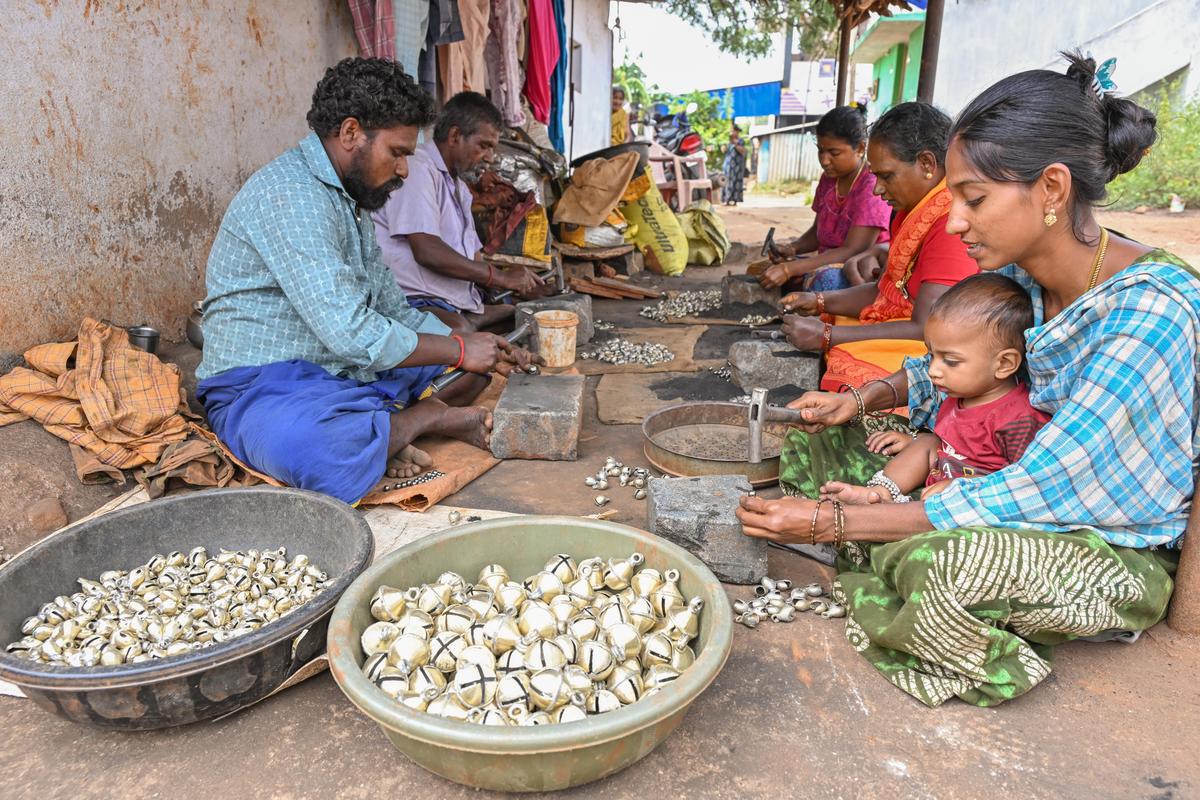
A family of bell makers at work in Venkatanayakanpatti.
| Photo Credit:
R. VENGADESH
Published – March 10, 2026 12:15 pm IST