



Four astronomy facilities announced in Union Budget to cost ₹3,500 crore, to be completed over a period of three to 13 years
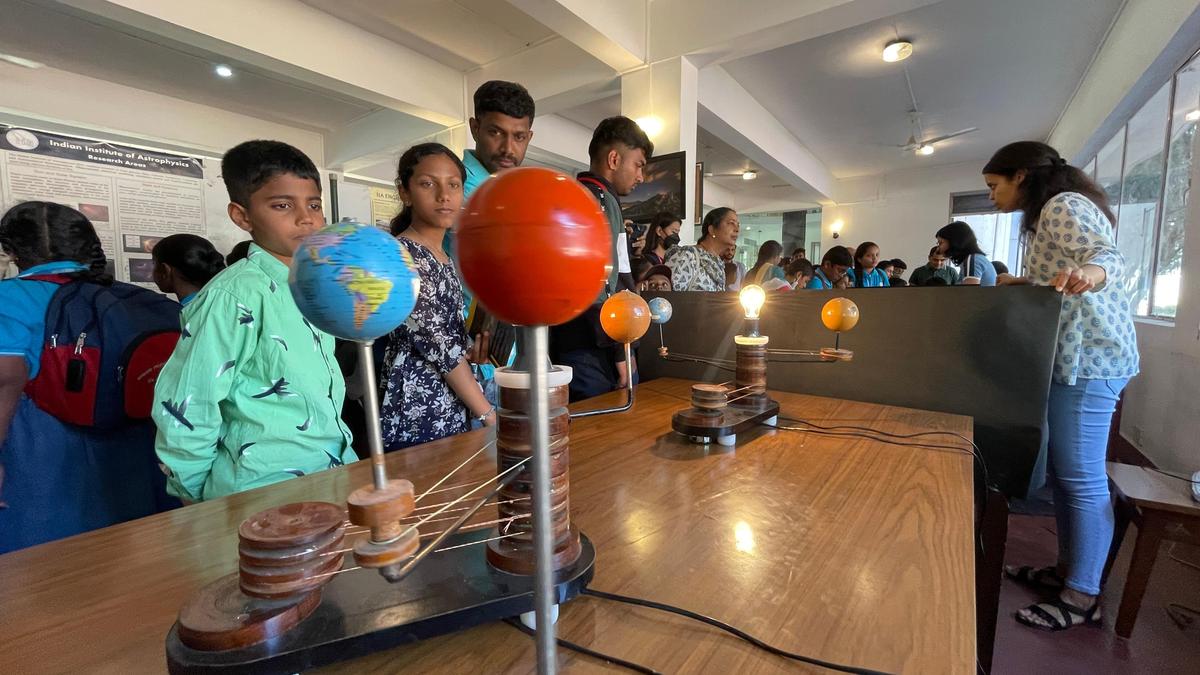
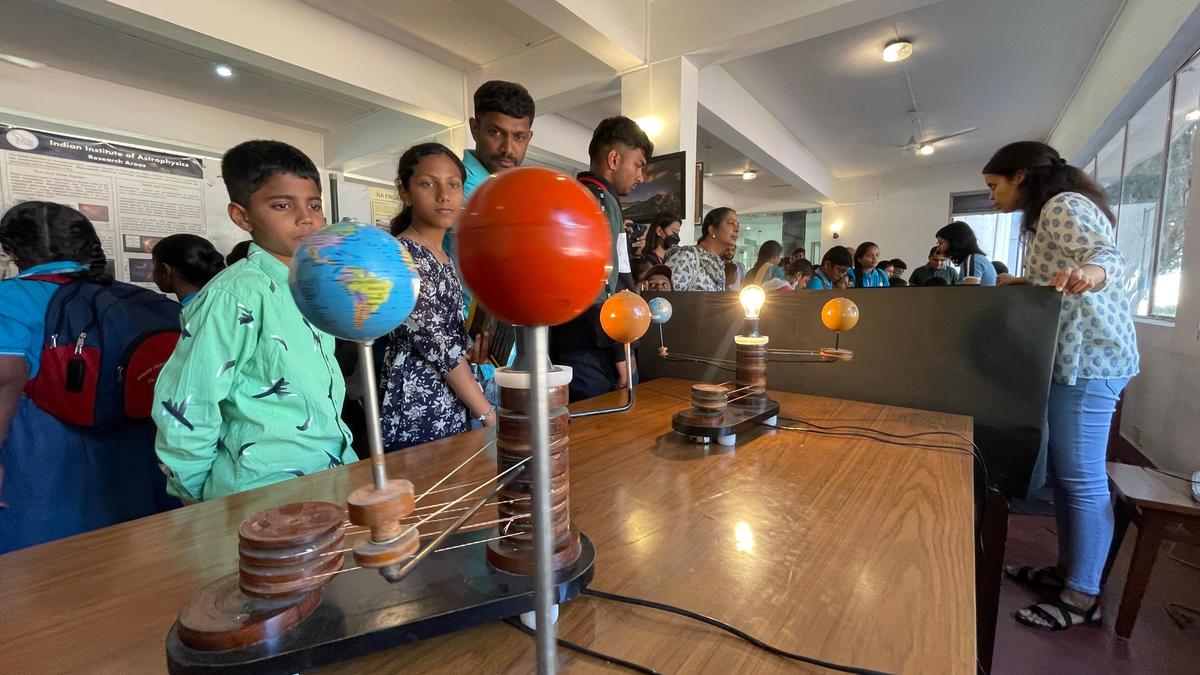
A file photo of visitors at an exhibition at Indian Institute of Astrophysics (IIA) in Bengaluru. All these projects will be overseen by the Bengaluru-based IIA.
| Photo Credit: File photo
The construction and upgrade of the four major astronomical facilities, which was announced in the Union Budget, is expected to cost about ₹3,500 crore, and a proposal for approval of the project will be placed before the cabinet.
A Department of Science and Technology official, while participating in the post-budget webinar on Telescope Infrastructure Facilities, on March 9 said, “We are at a stage where we will get approval from the expenditure finance committee and then it goes to the cabinet for approval. Any project over ₹1,000 crore needs to get approval from the cabinet. These four projects put together will be in the range of ₹3,500 crore,” he said.
The four projects announced in the Union Budget to promote Astrophysics and Astronomy via immersive experiences, are the National Large Solar Telescope (NLST), the National Large Optical infrared Telescope (NLOT), the upgraded Himalayan Chandra Telescope (uHCT) at Hanle in Ladakh, and the Cosmology Education and Research Training Centre (COSMOS 2) Planetarium. All these projects will be overseen by the Bengaluru-based Indian Institute of Astrophysics (IIA).
IIA Director Professor Annapurni Subramaniam, who moderated the session on the telescope infrastructure facilities, gave an outline of the four projects, which will be completed over a period of three to 13 years.
The NLST project, which is a two-metre telescope, will come up at Merak in Ladakh. Prof. Annapurni said that the NLST will be India’s next generation window to the Sun.
“The timeline for completing this project is five years. It will serve as the vital ground-based counterpart to the Aditya-L1 mission, providing high resolution magnetic maps. It will be strategically located to fill the observational void between major facilities in the USA and Europe enabling 24/7 global solar surveillance,” she said.
On the NLOT, she said that the project goal is to establish India’s first segmented mirror large aperture optical infrared observatory, which will enable frontier science in the era of multi-messenger multi-wavelength astronomy.
She said that the total duration of the project is 13 years, and the target first light will be in the year 2038.
Prof. Annapurni added that the uHCT at Hanle will be upgraded with multiplexing capability for key science drivers. such as spectroscopic classification of transients, milky way stellar populations, galaxy redshift surveys and active galactic nuclei demographics.
COSMOS 2 is expected to come up in three years in Amaravati, Andhra Pradesh. IT will have a 15-metre LED tilted dome with 15 degree inclination, and 150-seat sky theatre.
Published – March 10, 2026 10:22 am IST