


The Subaru Uncharted Is The Electric Crosstrek You Asked For, With A Big Asterisk
If you know Subaru buyers, you know why they want EVs. The company targets the exact sort of young, outdoorsy, practical buyers who favor efficiency and capability over speed and excess. And for 2026, the company is finally taking those demands seriously, with an updated Solterra, a new Outback-esque Trailseeker, and this, the Uncharted.
It’s the electric Crosstrek I’ve wanted for years, with solid dynamics, solid range, and a solid price. But Subaru and Toyota—which actually builds the Uncharted—are still stubbornly resisting EV-specific features, making this yet another electric option with an asterisk attached. And with a hefty price for its segment, it’s not the slam-dunk value I was expecting.
(Full Disclosure: Subaru put journalists up in a nice hotel on the water in Laguna Beach, California, for the first drive event. They gave us lots of food, too.)
2026 Subaru Uncharted: Specs & Competitors

Photo by: Mack Hogan/InsideEVs
The Uncharted sits at a weird spot in the EV landscape. It is based on the same platform as the Solterra and new Trailseeker, but in a tidier footprint that almost directly mirrors the gas hybrid Crosstrek.
That makes it a bit smaller than cars like the Chevy Equinox EV and Hyundai Ioniq 5, but its available 338-horsepower all-wheel-drive powertrain puts it a cut above other subcompact EVs like the Hyundai Kona EV, Nissan Leaf, and forthcoming 2027 Chevy Bolt. Still, to keep the pricing closer to those rivals, Subaru offers a front-wheel-drive version with 221 horsepower.
That’s a bit of a surprise, as the Toyota version is all-wheel-drive only, a typical hallmark of Subaru SUVs. Perhaps that’s because while both automakers helped develop all three of their core EVs, the Uncharted and CH-R are both built by Toyota, while Subaru builds the bZ Woodland and Trailseeker itself.
2026 Subaru Uncharted
Base Price
$36,445 (Premium FWD)
Battery
74.7 kWh
Charge Time
10%-80% in 28 minutes
Drive Type
Single-Motor FWD or Dual-Motor AWD
EV Range
Up to 308 miles
Output
221 hp (FWD) / 338 hp (AWD)
Charge Type
NACS
With 23 cubic feet of cargo space with the seats folded up, it’s got a slightly larger trunk than the Crosstrek, and a three-inch longer wheelbase for better rear seat room and shorter overhangs. The downside is its swept-roof design, which makes it the awkward duck of the Subaru EV lineup, at least to my eye. The good news is that Subaru’s focus on off-pavement adventures means you get 8.2 inches of ground clearance, which is excellent for an EV and far surpasses its rivals.
All Uncharteds get a 74.7 kilowatt-hour battery, good for up to 308 miles of range in front-wheel-drive spec. I’d expect most buyers to stomach the range and cost penalty associated with all-wheel drive, though, as this is a Subaru after all. The dual-motor version gets 287 miles of range on the Sport trim, but if you insist on the GT model’s bigger wheels and tires, you’ll have 273 miles to use.
27
Source: Mack Hogan/InsideEVs
Pricing starts at $36,445 for the Premium FWD model, $41,245 for the Sport AWD trim and $45,245. So sure, the Subaru offers more power and some more equipment than you’d get on many rivals, but you’re also going to pay quite a bit for it. In fact, the Uncharted isn’t even the cheapest AWD EV in Subaru’s lineup. The larger, better-looking Solterra starts at $39,945, and comes standard with AWD.
How Is It As A Car?
Photo by: Mack Hogan/InsideEVs
On and off the road, the Uncharted is quite lovely. I’ve never liked the software or specs of a Subaru or Toyota EV, but I’ve always been impressed by how they drive. The Uncharted has the same precise, quick steering as a Solterra or bZ, but in a tidier frame. The payoff for the smaller size isn’t all that noticeable from the driver’s seat, in part because all of the Subaru EVs feel lighter than the competition.
The Trailseeker and Solterra are genuine lightweights for their class. But the Uncharted is a bit heavy for the segment. The FWD version weighs 4,145 pounds, but the AWD model is considerably porkier, tipping the scales at 4,430 lbs in its lightest spec.
Photo by: Mack Hogan/InsideEVs
Still, I found the uncharted charming and precise on the road. And with a big 14-inch display featuring Wireless Carplay, physical knobs for climate controls and volume, and impeccable build quality, the interior is a nice place to spend time. There’s naturally no powertrain noise and little wind noise, but you can certainly hear the tires at speed.
But the real killer app is its ground clearance and all-wheel-drive system. Subaru correctly notes that anything this small available with all-wheel-drive—like the Mini Countryman SE or Volvo EX30 AWD—offers nowhere near this much range. The ground clearance, too, is exceptional, beating out any SUV in the compact or midsize class. If you want 8 inches or more of clearance, your options are the considerably longer and less capable Blazer EV, the other two Subarus, a Rivian, a BMW iX, a Lucid Gravity or an electric truck. That alone may make this a hit with certain buyers.
Photo by: Mack Hogan/InsideEVs
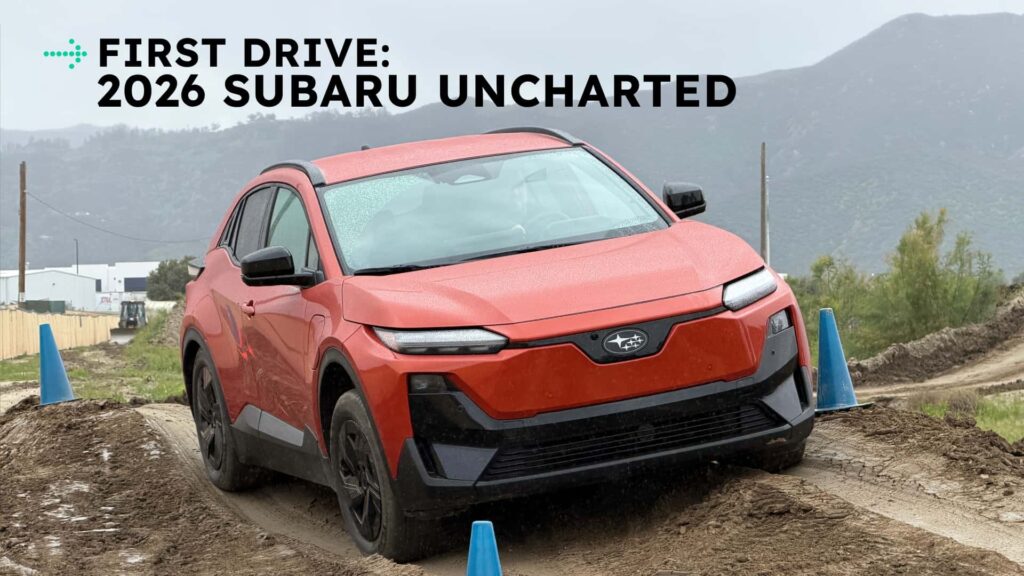
To show that off, Subaru set up a mild off-roading course at a motorsports park. Frankly, I don’t put much stock in courses that automakers design specifically to highlight their vehicles, but I will note that it gave me enough confidence to say this thing can comfortably handle your average fire road.
Its “X-Mode” brake-based traction system and “Grip Control” off-road cruise control were both helpful, and the available 360-degree “multi-terrain monitor” gave you a good view of obstacles in front of you. Unfortunately it is programmed to automatically turn off when you hit 7 mph and, in our experience, seemed to often turn off even before that.
How Is It As An EV?
Photo by: Mack Hogan/InsideEVs
This is a tougher answer. Factually, the specs are at or near the top of the class. With 308 miles of range from a 74.7 kWh battery, it’s EPA rated for 4.1 miles per kilowatt hour combined in FWD form, which is great. It also offers more power than competitors, a Tesla-style North American Charging System (NACS) port, and can charge from 10-80% in as little as 28 minutes.
Good, good, and good.
Yet there’s still something missing. The most middling EVs feel like they were designed as gas cars, but with batteries, and I still feel that way in the Uncharted. You can vary regeneration level by using the paddles on the steering wheel, but they always reset on start-up.
Even in its most aggressive regeneration setting—which is more abrupt feeling than many one-pedal modes—the car still won’t slow you from 5 mph to a crawl, meaning there is no one-pedal driving. The Uncharted also creeps when you lift off the brake, and you can’t turn that off.
Despite its weird gauge cluster design, too, with a floating digital screen that sits prominently above the wheel, the display itself looks ancient, with very little configurability. Switch to the main infotainment screen and the software is snappy enough, but extremely light on features. There’s no real EV-specific features and not much configurability. You get the sense that you’re supposed to set up CarPlay and never look at it again.
Photo by: Mack Hogan/InsideEVs
That’s fine in a gas car. But in an EV you need good software to solve EV-specific problems. For instance, while the car will now automatically pre-condition the battery for faster charging when you route to a DC fast charger, that only happens if you use the native map system. Which you won’t, because it isn’t as good as Google Maps.
Open the internal navigation in an Uncharted and ask it to route you to a destination 500 miles away, and it’ll also warn you that you can’t make it without a charging stop. But it won’t plan your charging stops for you, forcing you to rely on third-party planning apps that can’t use the car’s live state of charge to plan better routes.
This was a pain point when the Solterra launched in 2021, and it’s just unacceptable now. I get that Subaru may not want to route you to a broken charger, and that coding this feature is not trivial, but if you cannot develop an essential bit of EV software after five years of critical reception, your company is just not moving fast enough to keep up.
Early Verdict
Photo by: Mack Hogan/InsideEVs
Great EVs sell you on the promise of the technology. Cars with an ultra-polished software experience and common-sense features like route planning, utility modes, Sentry Mode, video streaming for charge stops, fun acceleration sounds, or phone-as-a-key support give you that. They help show buyers that EVs aren’t just more expensive versions of gas cars, loaded with batteries crammed in out of obligation. EVs are a new generation of transportation, with new possibilities, cool features, and a fully fleshed out ownership experience, so long as the manufacturer is willing to solve the teething problems for you.
I thought 2026 would be the year where Subaru and Toyota get there. It’s not, and that’s okay. Most automakers are still struggling with these things, and still will be for years to come. What’s important is that they keep improving.
On software, I’m still waiting to see proof that Subaru and Toyota are moving the ball forward. But as for the cars themselves, the progress is clear, and valuable. This is a much-needed third option in the lineup for a brand that has plenty of EV-curious buyers. But to really become a leader in tomorrow’s car market, Subaru needs an EV with either class-beating pricing or a world-class overall EV experience. The Uncharted is a lot of good things, but it isn’t that.
Contact the author: Mack.Hogan@InsideEVs.com