



GM’s Next-Generation EVs Are A Big Reset. Here’s What We Know
General Motors has one of the broadest electric-vehicle lineups in the United States, spanning everything from compact crossovers to full-size trucks. But the manufacturer is already preparing the next stage of its EV evolution, and some changes will even appear on the 2028 Cadillac Escalade IQ.
GM plans to roll out next-generation software with that model, which is also expected to be the first to feature lidar for more advanced autonomous driving capabilities and conversational AI. GM is also rethinking its next-generation EVs’ electrical systems, packaging options and wiring looms to fit a wide range of cars with or without a combustion engine.
In other words, GM’s future EV offerings are changing fast. Patrick George, our Editor-in-Chief, attended the GM Forward tech event in New York in October, where he was given a deep dive into how all of this works. And other GM executives have recently revealed new details as well. Here’s what we know so far.
GM’s Two-Pronged Plan: Software and Hardware

Photo by: Patrick George
GM’s Vehicle Dynamics Performance Integration Engineer Alexander Doss recently spoke to The Drive and revealed that the manufacturer is rethinking the physical aspects of its EV platform—and it could have multiple architectures that are better suited for certain sizes and types of vehicles. Doss said that it proved difficult to have just one platform and adapt it to work in a wide range of vehicles, which is what GM did with its formerly-named “Ultium” EVs.
Granted, that platform wasn’t a platform in the traditional sense of the word, but essentially a skateboard with a battery in the middle that could be stretched and shaped for different uses. “Ultium” was more of a shared EV toolkit used on top of various architectures, such as the BEV3 platform that underpins most of GM’s current model lineup.
The only exceptions are the brand’s trucks and SUVs, which ride on the BT1 platform but still have Ultium batteries, controllers, drive motors and other key shared EV components.
As Doss told The Drive, packaging wasn’t great with the current cars: they have huge, sweeping dashboards, they can struggle with efficiency, and they aren’t packaged like many competitors, hence no “frunk” for most models. “Packaging and mass” are among the top priorities for the next go-around.
An Evolution In Computing
Just as BMW has done with the Neue Klasse platform underpinning the iX3 and i3, GM wants to create a “centralized compute architecture” with fewer ECUs that control more functions. GM views the current way automotive electrical systems are designed as a bit archaic. As cars have gained new functions over the years, complexity has increased, resulting in excessively complex (and expensive) wiring harnesses.
Photo by: General Motors
GM says the new setup replaces a web of single-purpose modules with a high-speed Ethernet backbone that links a central computer to simpler “zonal” controllers placed around the car. Each zone manages nearby functions, so there’s less wiring and data moves faster and more efficiently. Deploying software updates also becomes easier, which is key in a true software-defined vehicle.
GM isn’t the only manufacturer moving away from domain-based architectures—components controlled by different, disparate computer systems, which have been the norm for decades—to zonal architectures. The old way doesn’t cut it in the age of the software-defined vehicle (SDV). This new way of doing things means less wiring and complexity, and not only helps the system run more efficiently, but it also helps the automaker cut costs where you will never notice it.
New Batteries, Eyes-Off Super Cruise With Lidar
Photo by: Patrick George
New batteries will increase the range of GM’s next-generation EVs. The company has joined forces with LG to develop new prismatic cells with a new LMR chemistry that contains a lot more manganese and significantly less nickel than the NMC batteries that are widely used among today’s EVs. The promise is that these new batteries will deliver improved range for GM’s larger trucks and SUVs. LMR batteries aren’t known to have the highest longevity, but even so, GM says it expects performance comparable to its earlier NMC packs, including in hot and cold conditions.
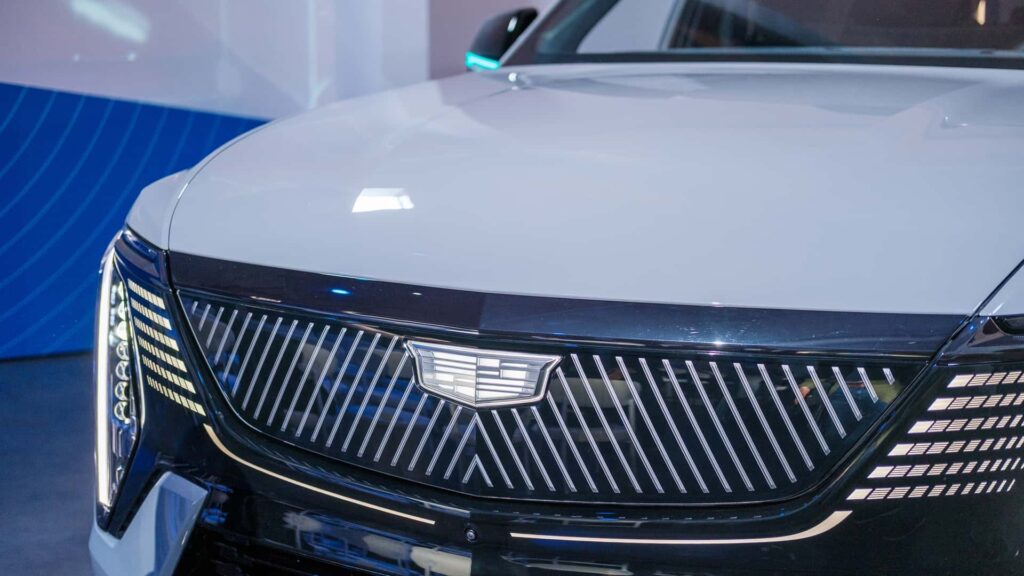
Eyes-off Super Cruise will debut in the 2028 Escalade IQ, taking one of the best automated driving systems available today to the next level. Super Cruise in current GM cars uses a combination of radar, cameras and high-resolution lidar-mapped roads to deliver a very smooth and reassuring driving experience, which allows you to take your hands off the wheel but not your eyes off the road.
Photo by: Cadillac
GM’s Escalade IQ concept used teal-colored lights to indicate when eyes-off mode is active. This mirrors what other manufacturers plan to implement in Europe and China, although it’s not an official eyes-off driving standard yet—and certainly not legally mandated like other lights are.
With the introduction of a forward-facing lidar (placed above the windshield) and more powerful computing in the Escalade, GM says the system could allow you to watch a movie while you drive. You will no longer have to pay attention to the road as the system will take care of the driving for you, although you won’t be able to activate the system on any road. At launch, it will be limited to select highways and conditions (still not fully detailed), with coverage expanding over time.
The new platform is designed to remain connected to the internet at all times, relying on a high-speed connection, presumably also used for automated driving functions. This also means the vehicle “will always be connected, awake, and available, with near-instant responsiveness to remote commands,” according to GM, which frames it as an important prerequisite for a true software-defined vehicle.