



Tesla Deleted Lots Of Features In The Model Y Standard, But It Didn’t Ruin It
Voices on the internet say the Tesla Model Y Standard is a variant to avoid. They argue that all the equipment it loses in the quest for improved affordability is enough to make it not worth considering. But is that really true?
Most of the criticism boils down to one idea: Tesla cut comfort and convenience features and that all adds up to make it feel cheap. So I treated the Standard like a normal car for almost two weeks, waiting for the moment it started to feel compromised and like a bad choice. It never came.
(Full Disclosure: Tesla loaned me a Model Y Standard to conduct this review.)
The Model Y Standard Makes Sense In Europe

Photo by: Andrei Nedelea
Sure, it’s not as nice as the Model Y Premium, whose suite of features does make it feel a cut above, but the Standard is still a lot of electric crossover for the money. Here in Romania, where I tested it, its €39,990 price tag before any incentives or discounts are applied makes it a very attractive buy.
(Note: In the U.S., Tesla no longer calls this the “Standard,” instead labeling it the Model Y, with the more typical version now called the Model Y Premium. For clarity, we refer to it as the Standard throughout.)
You can’t get another similar EV here for less, and even in Standard trim, the Model Y has more standard equipment than more expensive rivals like the very popular Skoda Enyaq, which you see a lot around here (starting at just under €43,000).
What €39,990 buys you is the same body, the same packaging, and the same core usability as the regular Model Y, including access to the vast network of Superchargers, a genuinely massive cargo area and more performance than other base models.
Photo by: Andrei Nedelea
The only other electric crossover that starts around the same price point in Europe is the Ford Explorer EV (based on Volkswagen’s MEB platform), but it’s a foot shorter, smaller inside, and not particularly premium-feeling. Probably the best alternative here in Europe is a base Hyundai Ioniq 5, which has a larger battery and more range. It only costs from €41,000, delivering 354 miles (570 km) WLTP on one charge, while the Tesla can only reach 331 miles (534 km), albeit with a smaller battery pack.
It’s a slightly different story in the U.S., where you can get rivals for less than its $39,990 starting price. The Chevrolet Equinox EV, Toyota bZ and Ford Mustang Mach-E in base trim all undercut the Model Y Standard and offer comparable specs. The Standard, therefore, makes more sense in Europe than in the States, where more affordable options are available.
But even if it’s not as cheap as rivals and in the U.S., does that mean you should avoid the Model Y Standard?
A Tour Of All The Missing Stuff
Photo by: Andrei Nedelea
Tesla didn’t reinvent the Model Y for the Standard. It just removed a series of features. My approach while reviewing the car was not to focus on what was removed, but instead see if any of the changes became annoying over time. After a few days with the car, the fact that it was a Standard became less important. It just felt like a typical Tesla, not a step down.
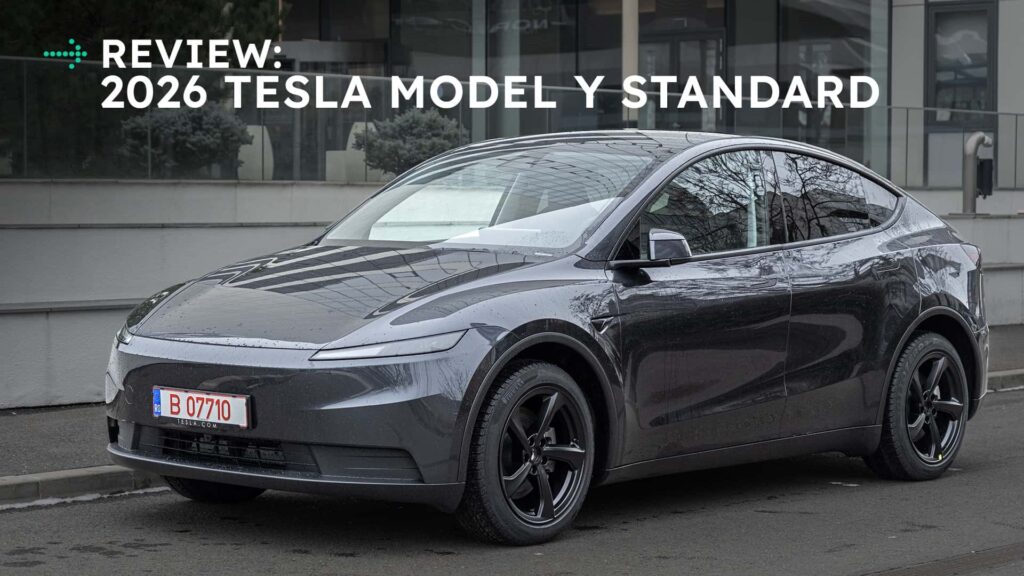
The most obvious changes are to the front and rear fascias, which get simplified illumination, and the smaller wheels. Step inside and you’ll notice the part-cloth interior upholstery. The door panels are also slightly redesigned, made from a cheaper-feeling plastic, and there is no more ambient lighting anywhere in the cabin.
When adjusting your driving position, you discover there are no more physical controls to adjust the driver’s electric seat, so you have to access a menu on the central infotainment screen to do it. The passenger’s screen adjusts the same way, but in the Standard, it loses its height adjustment (you can’t even raise or lower it manually) and you can only control the rake of the backrest and the forward and back movement of the entire seat.
Photo by: Andrei Nedelea
It feels a bit silly to use the screen to adjust the electric seats, but I did it once for the driver’s seat and never touched it afterward. What felt like a bigger omission was the lack of height adjustment for the front passenger seat, which represents actual lost functionality over a Premium Model Y.
The steering column adjustment is not electric in the Standard. There is still a lot of adjustability in the helm position, and you still get one of the best driving positions in the business behind the wheel of a Model Y Standard. If you have multiple drivers using the same vehicle, you’ll have to manually adjust the wheel position every time you switch, while the seat adjusts automatically for each driver once the positions have been memorized.
The center console is different from what you get in the Premium and instead of cubbies hidden by sliding lids, you get a large tray that can hold a decent-sized shopping bag that you can’t be bothered to put in either trunk.
Photo by: Andrei Nedelea
The second row also loses features. There’s no rear screen and no separate climate zone, and you have to adjust the air vents manually in the Standard. The rear armrest is also gone, and instead, the entire middle section of the rear backrest is used. It’s too low to function as a true, comfortable place to rest your elbow, but at least it still has cupholders.
Probably the biggest change rear occupants will notice is lack of a panoramic glass roof. The glass is actually still there, only hidden by the headlining that covers the glass. That’s still a baffling choice, especially since the Model 3 Standard keeps its see-through roof. If you plan to routinely carry adults in the back, these are changes and missing features that they will actually miss.
Gone, too, is the electric folding mechanism for the rear bench. You now have to fold each seat down manually and then get into the back seat to put them back up. The trunk capacity remains unchanged, though, so it’s just as practical but not as convenient and easy to configure for different needs.
Photo by: Andrei Nedelea
The change that I like the least in the Standard is the frunk, which is much worse than in the Premium. It’s a new pressed piece that looks like it’s made of recycled materials, so it feels cheap. It has less capacity and isn’t weather-sealed, so you shouldn’t put any electronics or anything that could be damaged by water in there. And when you close the frunk, it makes a mildly alarming hollow metal noise; that’s much more subdued in the Premium.
Now that sounds like a lot of features that have been removed, but living with the vehicle, they don’t have a big impact on the quality of life aboard the Model Y. You still get heated seats in the front, a heated steering wheel and a decent sound system, even with half the speakers. The cloth on the seats doesn’t feel cheap or unpleasant.
Still Competent, With Fewer Toys
Photo by: Andrei Nedelea
Start driving the Model Y Standard and you notice a difference in ride quality compared to the Premium model. This is because the Standard does away with the Premium’s fancier frequency-selective dampers in favor of simple, passive shocks. It feels a bit stiffer over bumps than the Premium, but it’s nowhere near as harsh as the pre-facelift model.
I think I actually prefer the way the Standard feels, since it seems to control its mass better through the corners. My tester was equipped with 19-inch wheels wearing winter tires, so I can say what the Standard 18-inch wheels with chunkier tires feel like. But they probably enhance the ride quality slightly while making feel less sporty to drive.
So, even though it feels a bit harsher than the Premium, the Standard is still a nice-riding car that stays composed even on bumpy, uneven roads.
Photo by: Andrei Nedelea
The Standard is also the slowest Model Y you can buy. The German-built Model Y Standard is quoted as accelerating from a standstill to 100 km/h (62 mph) in 7.2 seconds. That’s not the only difference: U.S. models are also available with optional all-wheel drive, a $2,000 option that drops the 0-60 mph time to 4.6 seconds. Tesla doesn’t quote the power rating of any of its models, but I’d bet the Euro-spec Model Y Standard has less than 300 horsepower. It’s not slow, but noticeably slower.
It’s also louder than the Model Y Premium. I heard much more motor whine and suspension noise in the Standard, suggesting it has less sound dampening than the premium. The level of wind and road noise at higher speeds seemed very similar to the Premium, though. You mainly hear the difference when you accelerate hard in the Standard.
So Should You Avoid It?
28
Source: Andrei Nedelea
Many reviewers seemed to judge the Standard by what it lacked compared to the top model. However, I think Model Y Standard buyers care more about what they get for the price, which is why early sales of the model are reportedly strong.
My takeaway from living with a Model Y Standard is that most of what Tesla changed or removed doesn’t fundamentally alter the vehicle. It’s definitely worth considering, especially for those with a strict budget. If you have a strict €40,000 or $40,000 limit you can’t go over, buying the Standard makes sense.
It gives you 90% of the typical Tesla experience. For most people, that’ll be enough.