




India-U.S. trade deal is a blow to India’s strategic autonomy
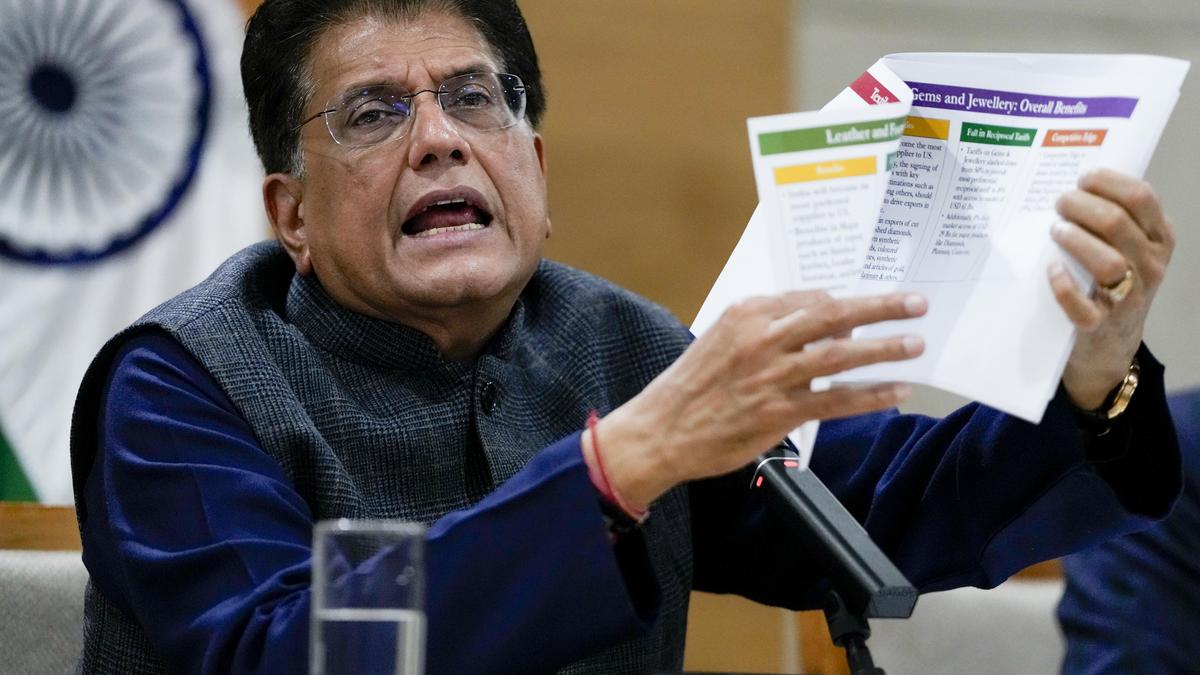
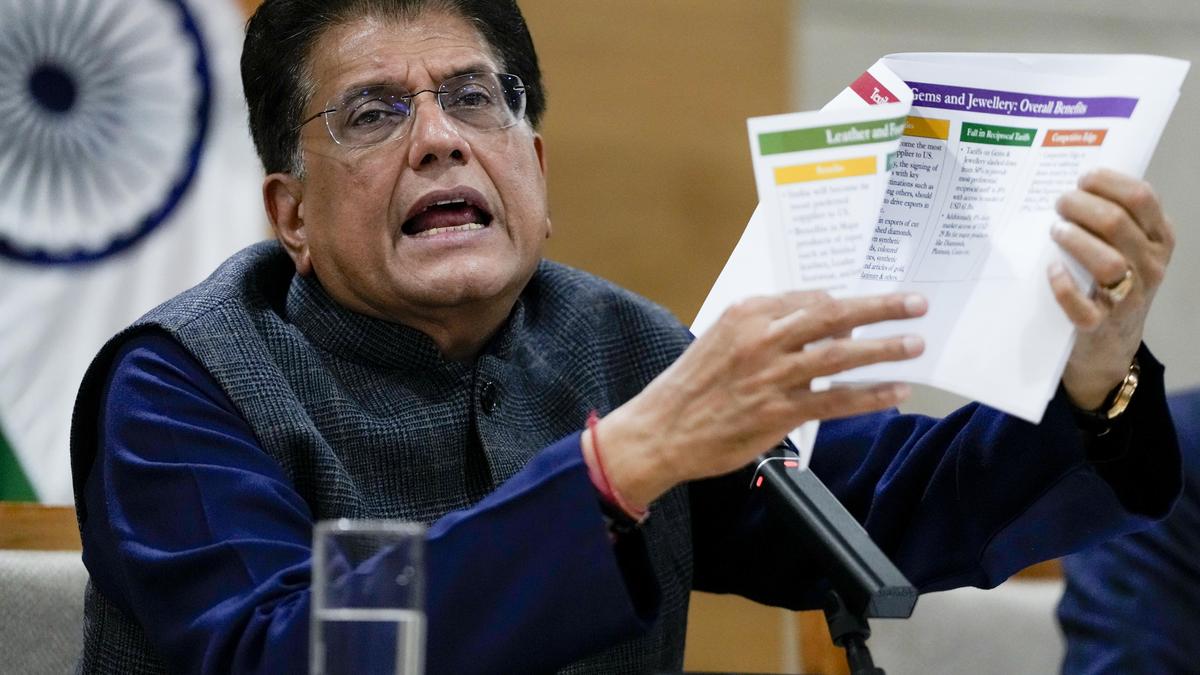
Union Commerce and Industry Minister Piyush Goyal at a press conference on the India-U.S. trade deal in New Delhi on February 7. While India’s intention to purchase $500 billion worth of U.S. goods in the next five years is mentioned in the text of the interim agreement, there is no reciprocal commitment to increase U.S. imports from India to a similar level.
| Photo Credit: PTI
The “framework for an Interim Agreement regarding reciprocal and mutually beneficial trade”, announced through the U.S.-India joint statement issued on February 6, raises serious concerns regarding India’s economic and geopolitical future. An unequal and unfair bilateral trade deal is being brazenly imposed on India by the Trump administration. By agreeing to such terms, the Modi government is surrendering India’s national interest.
Unequal trade deal
The very premise of the Interim Agreement, defined as “a common commitment to reciprocal and balanced trade based on mutual interests and concrete outcomes”, works against India’s economic interests. The current nominal GDP of the U.S. is seven times larger than India’s GDP and its per capita income is over 30 times higher than that of India. Why has the Indian government made commitments towards “reciprocal and balanced trade” with a much larger and richer economy?
As per the text of the agreement, India has agreed to zero or reduced tariffs for “all U.S. industrial goods and a wide range of U.S. food and agricultural products, including dried distillers’ grains (DDGs), red sorghum for animal feed, tree nuts, fresh and processed fruit, soybean oil, wine and spirits, and additional products”. India has also agreed to eliminate non-tariff barriers (NTB) on U.S. exports of ICT goods, medical devices, food and agricultural products, etc. India’s intention to purchase $500 billion worth of U.S. energy products, aircraft and aircraft parts, precious metals, technology products, and coking coal over the next five years has also been built into the text of the framework agreement.
Such massive trade concessions to the U.S. could completely transform the structure of India’s foreign trade. The U.S. has been the largest market for Indian goods exports since long, with Indian exports to the U.S. crossing $86 billion in 2024-25, accounting for over 19% of India’s total exports of $437 billion. While India’s trade deficit expanded to $283 billion in 2024-25, it had a trade surplus of over $40 billion with the U.S. In 2025-26 (April-December), India’s goods trade surplus vis-a-vis the U.S. stood at $26 billion, with imports from the U.S. crossing $ 39 billion.
It is noteworthy that while India’s intention to purchase $500 billion worth of U.S. goods in the next five years is mentioned in the text of the interim agreement, there is no reciprocal commitment to increase U.S. imports from India to a similar level. This thoroughly exposes the Modi government’s exaggerated claims of enhanced potential for Indian exports following the reduction of the U.S. reciprocal tariff rate to 18%. Such an unfair bilateral trade agreement will eliminate India’s present trade surplus vis-a-vis the U.S. and convert it into a deficit in the next five years, with a surge of American imports into India. The losses of domestic market shares by Indian industrial producers and farmers will far exceed the gains made by Indian exporters, if any.
Eroding economic sovereignty
The U.S. President has also issued a separate Executive Order on February 6, alongside the release of the U.S.-India joint statement, making it clear that the withdrawal of the additional 25% import duty on Indian exports, is conditional to India’s discontinuation of crude oil imports from Russia. The executive order states: “Specifically, India has committed to stop directly or indirectly importing Russian Federation oil, has represented that it will purchase United States energy products from the United States, and has recently committed to a framework with the United States to expand defense cooperation over the next 10 years.”
The order goes on to state that the U.S. Secretaries of Commerce and Treasury will monitor India’s oil purchases, and the additional 25% import duty will be reimposed by the U.S. if India “resumes directly or indirectly importing Russian Federation oil”.
Data from the Indian Ministry of Commerce and Industry suggest that India’s crude oil imports from Russia increased from 50.85 million metric tonnes in 2022-23 to 83.02 MMT in 2023-24 and further to 87.54 MMT in 2024-25. The price per barrel of Russian crude oil had declined from $79.41 to $66.49 between April 2022 and March 2025. The share of Russian Urals oil in India’s total crude oil imports rose from below 2% in 2020-21 to over 35% in 2024-25. Russian crude’s share has already started falling in 2025-26, and is expected to drop below 20% by the financial year-end.
The Modi government’s genuflection on Russian oil imports at a discounted rate can possibly expand India’s current account deficit and further devalue the rupee, besides reversing the moderation of domestic retail inflation. The interim trade agreement, seen in totality with the U.S. President’s Executive Order on Russian oil imports by India, is a recipe to rob India’s strategic autonomy and transform its economy into an American dependency. Parliament must restrain the Modi government from inflicting such irreparable self-harm.
Prasenjit Bose is an economist and Congress leader. Views expressed are personal
Published – February 09, 2026 12:42 am IST