





Global firms are now trusting India for their most advanced semiconductor work: Minister Ashwini Vaishnaw
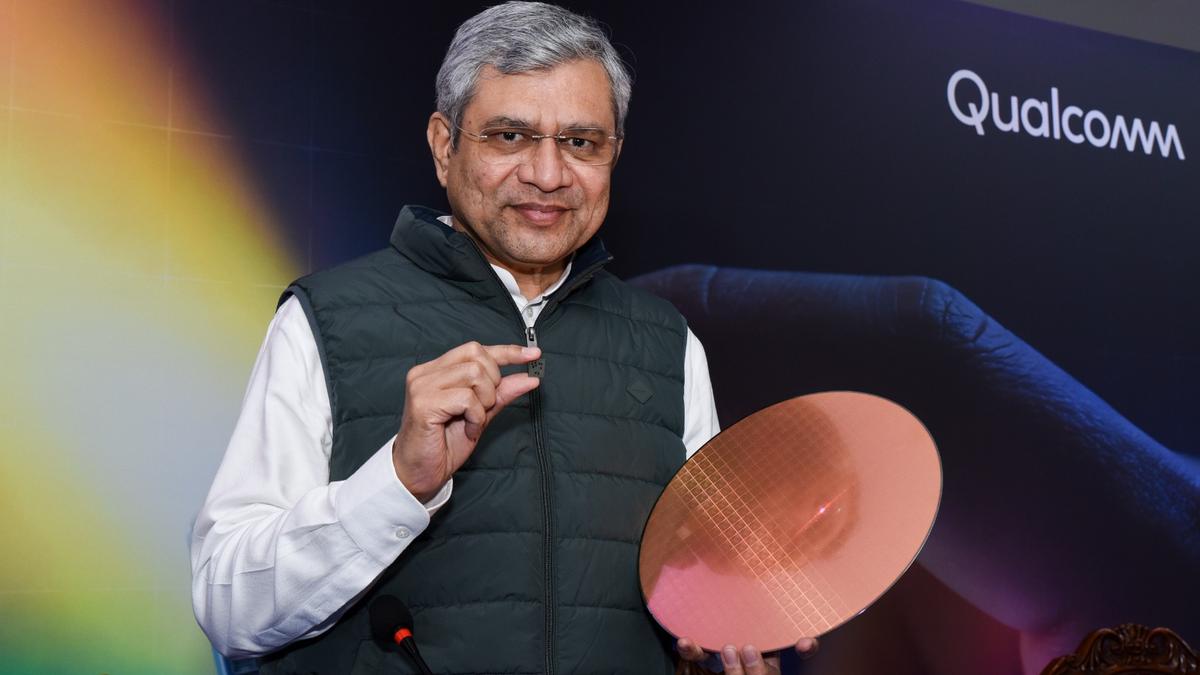
“This breakthrough placed India firmly in the league of countries working on cutting-edge chip design, alongside companies such as AMD that have already showcased such capabilities,” Union Minister Ashwini Vaishnaw said during the Texas Instruments new product research and development inaugural event, in Bengaluru on February 7, 2026. Photo: Special Arrangement
India is making significant progress in the semiconductor manufacturing design, although a new industry, the entire ecosystem is getting ready in the country, said Ashwini Vaishnaw, Union Minister for Electronics and IT in Bengaluru on Saturday (February 7, 2026).
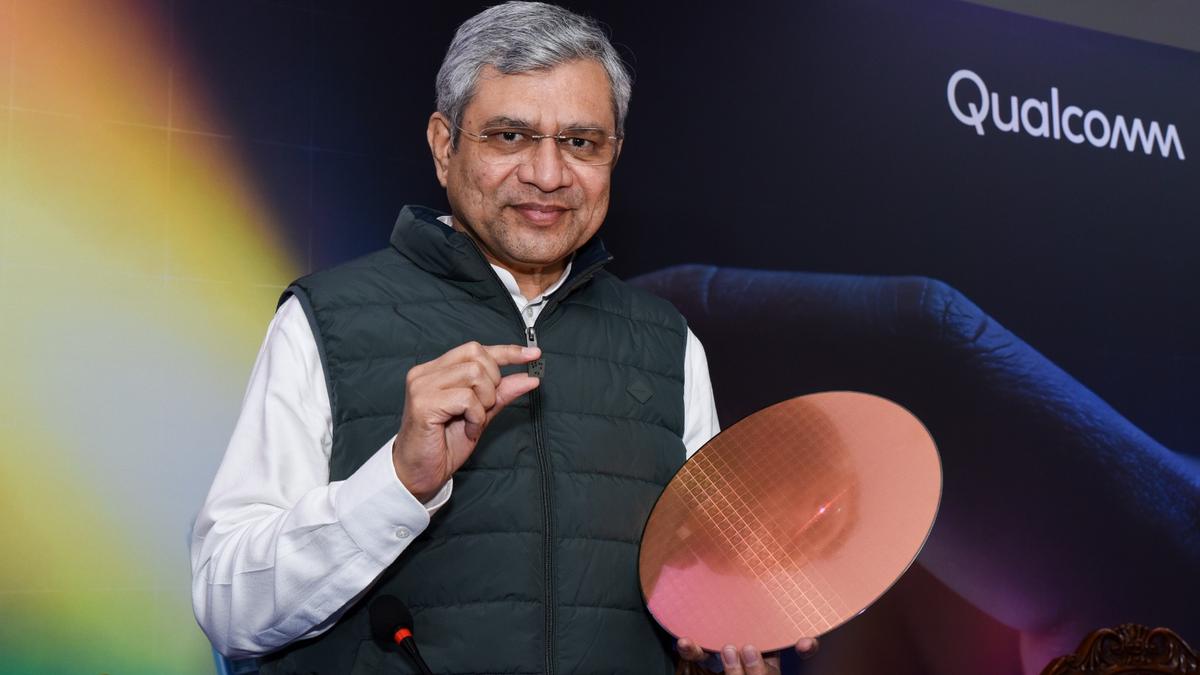
Commenting on the progress the country has been making in the sector, Minister Vaishnaw, while releasing the new 2-nanometre Qualcomm chip in Bengaluru, said the developments marked a change in India’s earlier role as a software service provider and a back-office to an end-to-end semiconductor product design and development hub.
“Today, we unveiled the two-nanometre wafer, two-nanometre chip at Qualcomm. This is part of a series of developments where companies are now designing in the country to develop the industry,” the Minister said, adding that the announcement of the 2-nanometre chip tape cut by Qualcomm also indicated how global firms were now trusting India with their most advanced semiconductor work.

Each chip carried supercomputing power, with about 20–30 billion transistors per die (silicon). That kind of density allowed a GPU and a CPU to sit within a small chip, Mr. Vaishnaw elaborated, showing the wafer to the media. “The final module can function as an AI computer across devices: desktops and cameras to routers, automobiles, trains, aircraft, networking equipment and industrial systems etc supporting edge computing and AI-led high performance computing applications,” he said.
Later speaking at a press conference, the Minister said, this breakthrough placed India firmly in the league of countries working on cutting-edge chip design, alongside companies such as AMD that have already showcased such capabilities.
“Data centres are going to be a major growth journey in the coming years. So far, we have committed $70 billion dollars in investments, with recent announcements the figure will be $90 billion,” the Minister said. Semiconductors were a long-term national project which has a scope for a multi-decade journey and based on industry discussions, he said the investments could further rise in the coming years and may exceed $200 billion as AI adoption accelerates, he indicated.
On talent preparedness, Mr. Vaishnaw said, under the Semicon 1.0 mission, the government had set a target of training 85,000 semiconductor professionals over 10 years. In four years, some 67,000 semiconductor engineers were trained. Students in some 315 universities and colleges have access to electronic automation tools and were actively involved in designing chips, he added.
Published – February 07, 2026 08:36 pm IST