

Kia EV Sales Are In An Absolute Freefall. There’s More To It Than You Think
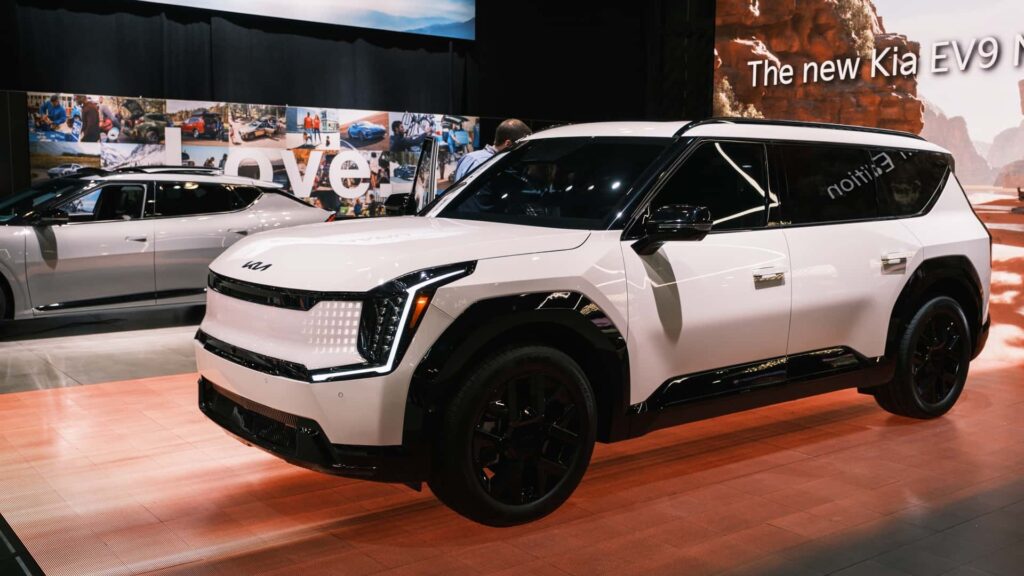
- Kia was one of the first legacy automakers to launch great EVs, with the EV6 and EV9 arriving to critical acclaim.
- But both posted huge sales declines last month, in part due to an industry-wide EV slowdown.
- That’s not the whole story, though, as the mechanically identical Hyundai Ioniq 5 is selling far better than the EV6. Here’s what’s going on.
Kia’s electric-vehicle fortunes seem to have turned. The 2021 launch of the EV6 propelled the South Korean brand to the front of the pack among legacy automakers, offering blazing-fast charging speeds and excellent performance. Then the EV9 arrived to widespread acclaim, nearly taking home our first Breakthrough Award. But two years later, despite an overall January sales record for the brand, EV sales are collapsing.
Kia sold 674 three-row EV9s last month, down 45% compared to January of 2025. But the EV6—ostensibly Kia’s “high volume” model—fared even worse. Sales collapsed from 1,542 units in January 2025 to 540 units last month, a staggering 65% decline. That’s after a brutal 2025, too, where EV6 volumes fell 40% and EV9 sales fell 31%
So what’s happening?

The 2025 Kia EV6 got a major upgrade, with new batteries, better software and a Tesla-style North American Charging System (NACS) port. But sales still declined sharply last year.
Photo by: Patrick George
A few things. First off, I’d be remiss not to mention that the entire EV industry is seeing a contraction in the U.S. market right now. The $7,500 federal clean vehicle tax credit expired at the end of September, effectively making the U.S.-built EV6 and EV9 $7,500 more expensive and putting a damper on federally subsidized leases. Kia, like other automakers, hit back by offering up to $10,000 in manufacturer incentives on purchases for a period of time.
On top of that, tariffs have hit the company’s core business, giving it less free cashflow to offset this change.
You’d expect, therefore, to see a sales decline. But there’s also a Kia-specific issue here, I’d argue. The Hyundai Ioniq 5, which is mechanically identical to the EV6 underneath, saw only a 6% decline last month. And it was falling from a much, much, higher baseline. Hyundai sold 2,126 Ioniq 5s in January, and 47,039 of them in 2025. Meanwhile, Kia moved just 12,933 EV6s last year, despite a similar refresh that added a North American Charging Standard (NACS) port and better software and range.
From the outside, it looks like a failure of marketing. But Kia executives say it’s more to do with plant logistics.
“Look at it this way,” Kia’s U.S. marketing boss, Russell Wager, told me at the Los Angeles Auto Show in November. “We make the EV9 and EV6 in West Point, Georgia. We also make the Telluride, Sorento and the Sportage there. We have the flexibility of moving production between those five models to meet the customer, right?”
The Kia EV9 is one of our favorite family haulers. But its closest competitor is the Hyundai Ioniq 9.
Photo by: Kevin Williams/InsideEVs
As hybrid demand has boomed, for instance, Kia has adapted the mix at its plant. Perhaps that’s why both the Telluride and Sportage had record sales year, while the EVs have faltered slightly. But Hyundai is unconstrained by this issue. In fact, it’s incentivized to make as many Ioniq 5s and Ioniq 9s as possible to justify its giant new EV-oriented “Metaplant” in Georgia.
“They make the Ioniq 5 and the Ioniq 5 in Savannah, Georgia, at the Metaplant,” Wager continued. “Great plant. We’re gonna make a product there next year. But right now, their flexibility is they make those two products. And plants need to run.”
That’s true, in that car factories are extraordinarily expensive assets, and companies are constantly looking to maximize their return on investment. That does explain why Kia has focused on gas and hybrid SUV production at the expense of EVs. But it does not fully explain the relative failure of the EV6 and the Ioniq 5, because it existed long before Hyundai and Kia built EVs in the U.S.
The Hyundai Ioniq 5 (pictured) and Ioniq 9 are both built at Hyundai’s Georgia “Metaplant.” Kia says that plant’s capacity is a major reason why the Ioniq 5 dominates the EV6 on the sales charts.
Photo by: Mack Hogan/InsideEVs
In 2023, the first full-year of normal sales for both models, Hyundai sold 33,918 Ioniq 5s, compared to the 18,879 EV6s Kia sold over the same period. Perhaps there was a similar volume constraint at the Hwaseong, Korea plant where the EV6 was built that didn’t effect the Ulsan plant that made Ioniq 5s.
But I’d wager that consumer preference is definitely factoring here. I actually prefer the EV6’s design, but its squat, raked-back shape does not always scan as an SUV, the way that an Ioniq 5 does. The Ioniq 5 is also more spacious and, in my view, has better ergonomics thanks to its separate media and climate controls. (The EV6 has a weirder solution, which I hate.)
Plus, there’s typically a snowball effect with product sales. The more you sell, the more you sell, as consumers see your product in the real world more often. That’s certainly true of the Ioniq 5, which is a traffic-jam staple anywhere EVs are popular.
But that presents an issue for Kia. After years of playing second-fiddle to the Ioniq 5, the EV6 has mostly dropped out of the public conversation, at least in the EV circles where I run. I hear about the Ioniq 5 far more often, and see a lot more content about it online. The EV6, by comparison, feels like a has-been. The company hasn’t really promoted the updated EV6 the way that Hyundai has advertised the much-improved Ioniq 5.
The Kia EV9 still outsells the Ioniq 9, which only arrived last year. We’ll see if the trend holds this year.
Photo by: Suvrat Kothari
The EV9, too, may be suffering from intra-Hyundai Motor Group competition. In its first year on sale, it won praise for being the first mainstream three-row electric SUV. But a year later, Hyundai launched its own version, the Ioniq 9. We haven’t seen a full year of sales yet, but it’s already nipping at the EV9’s heels, with 580 January sales compared to the EV9’s 674. If the plant constraints Wager referenced are the real limit, here, we could see these two reverse their positions this year.
For Kia’s sake, I hope that doesn’t happen. The company is an EV innovator, and should be more than just a shadow of Hyundai’s efforts. Hell, our editor in chief owns an EV6. That car was an early sign of a legacy automaker really committing to the EV market.
Now, it and the EV9 are fading from lots and roads alike as Kia prioritizes its gas and hybrid SUVs. That’s a reasonable strategy in today’s market, as proven by Kia’s record-setting sales. But if it wants to keep its status as a heavyweight in the EV world, Kia needs to inject some excitement into its EV lineup.
Contact the author: Mack.Hogan@insideevs.com