



Toyota And Daihatsu’s Tiny New EV Vans Solve A Modern Problem The Old-School Way
- Daihatsu and Toyota’s new electric kei vans can export energy from their LFP batteries.
- The vehicle-to-load (V2L) outlet is inside, and the CHAdeMO port up front is compatible with vehicle-to-home (V2H).
- When it rains, tools can be left plugged in, and the interior kept dry, thanks to an interesting accessory.
Daihatsu, a small Japanese automaker that’s known for its diminutive models, just unveiled its first mass-produced electric models. The new Daihatsu e-Hijet Cargo and fancier e-Atrai RS are powered by a new electric powertrain that was developed with the help of Suzuki and Toyota.
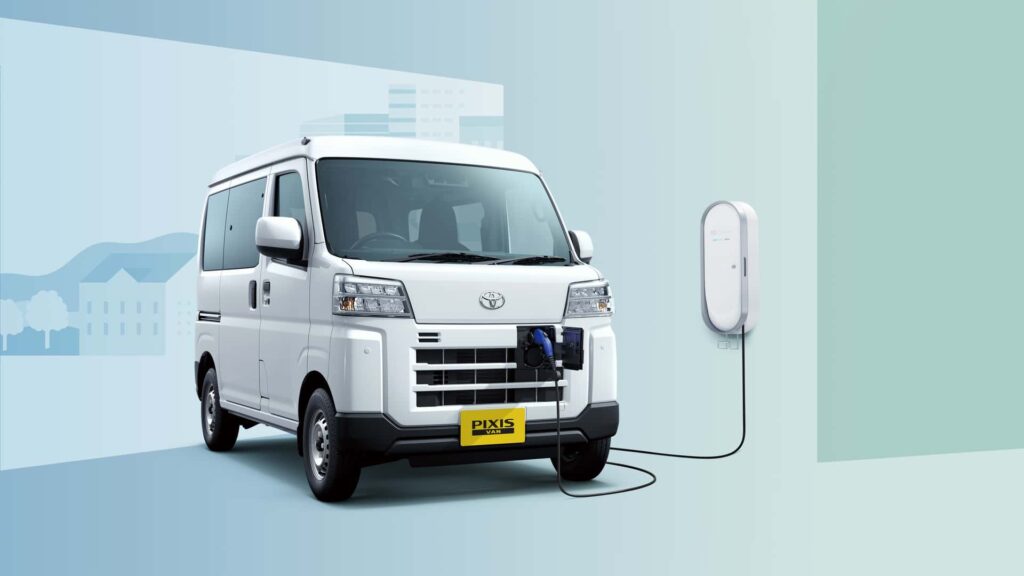
In fact, Toyota has its own version of the new electric kei van, called the Pixis Van BEV, which is built by Daihatsu at its Nakatsu factory in Japan’s Oita prefecture. That’s not exactly a surprise, though, seeing how Toyota owns Daihatsu.

Photo by: Toyota
What is a surprise, however, is the old-school solution to a modern problem that new-generation EVs inadvertently created. Like a lot of new electric cars, Daihatsu’s new Hijet kei van can export energy from its lithium iron phosphate (LFP) battery to power tools, appliances and even an entire house during an outage.
That’s because the e-Hijet’s electric architecture has vehicle-to-load (V2L) and vehicle-to-home (V2H) functionality baked in. On the V2H front, the tiny EV’s front-mounted CHAdeMO fast charging port can be used to keep the lights on, but additional hardware is needed.
On the V2L front, however, things are much simpler. There’s a 100-volt household outlet right on the center console, which can output a maximum of 1,500 watts, according to Daihatsu and Toyota. That’s pretty standard these days, with lots of EVs offering household outlets inside, while others–like Hyundai and Kia–offer an adapter that plugs into the charging port.
However, I can’t think of any other EV that has what Daihatsu’s new e-Hijet has. And that’s a neat plastic accessory that can be fitted on top of the driver’s side window. It has a pass-through for a cable, so any tool or appliance that needs power outside doesn’t need to be unplugged when it rains. It’s similar to the vents that are sometimes used on RVs–simple, effective, with no modifications needed.
Photo by: Toyota
On the engineering front, the tiny electric vans are pretty cool, too. They’re powered by a 36.6-kilowatt-hour battery pack that’s fitted low in the floor. The compact rear e-axle makes 63 horsepower and integrates the motor, inverter and reduction gear into a single unit. As a result, the electric Hijet’s 772-pound (350-kilogram) maximum loading capacity is the same as the gas version.
The battery enables a cruising range of up to 160 miles (257 kilometers) on a full charge on the WLTC cycle. That’s more than any other electric mini commercial van in Japan, per Daihatsu. Recharging the pack from when the low battery warning comes on the dashboard up to 80% takes about 50 minutes.
All of this sounds pretty sweet, but there is one downside. The gas-powered version of the Daihatsu Hijet is available with either two-wheel drive or all-wheel drive, while the e-Hijet only comes with rear-wheel drive.
There’s also the fact that these electric kei vans will be pretty rare, even around Japan. Daihatsu said it targets a monthly production of 300 units, with an additional 50 units for the Toyota-badged model.
17
Source: Toyota