




Belligerent and uncomplicated — pocket-dynamite Kishan is here to stay
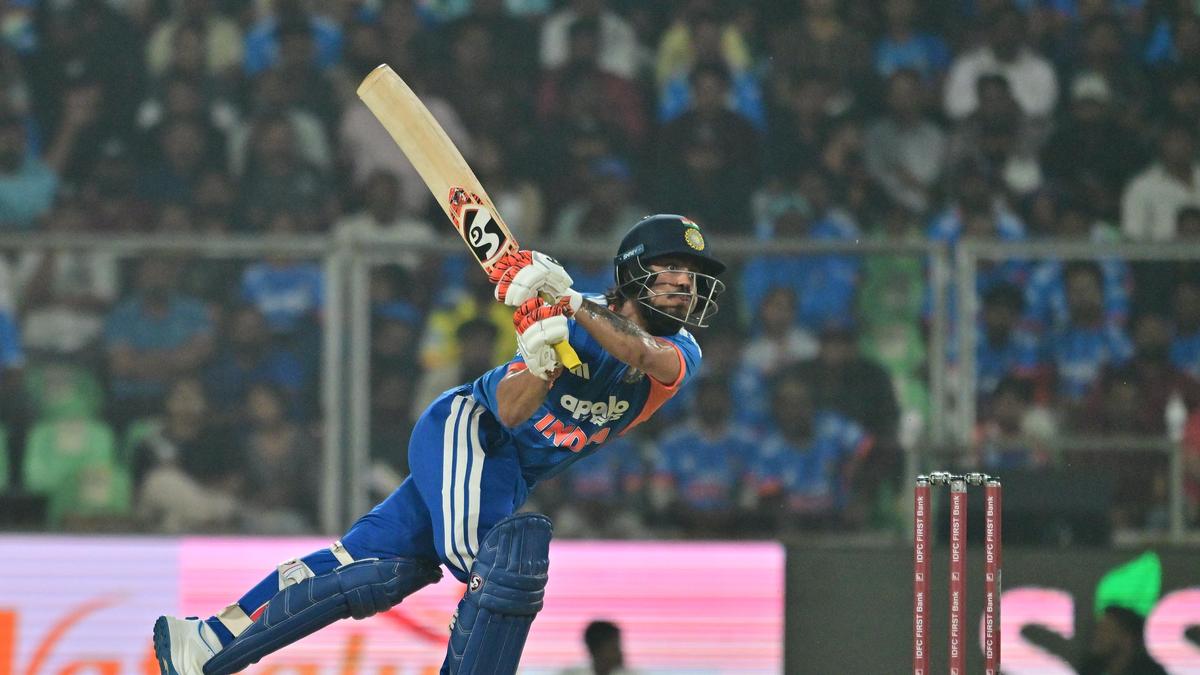
A little after 7.30 p.m. on Saturday in Thiruvananthapuram, chants of ‘Ishaaaan, Ishan’ rang around the Greenfield International Stadium as everyone packing the stands roared as one in approbation. After an uncharacteristically tepid start, Ishan Kishan had started to find his bearings, manifesting his aggression with a four and a six, through and over the off-side, off successive deliveries from Lockie Ferguson, who had accounted for both Indian wickets to fall at that stage.
What’s the big deal, you say? An Indian crowd cheering an Indian batter at an Indian venue? Isn’t that how it always has been?
But yes, this was a big deal. Here’s why.
One of the two wickets in the pocket of Ferguson, the tearaway Kiwi playing his first match of the T20I series, was that of Sanju Samson, hometown hero bar none, the toast of God’s own country, the man who can do no wrong even when he is exasperatingly infuriating with the bat.
Samson had just 40 runs in four outings coming into the final match, and desperately needed a score of substance to stay ahead of Kishan in the race to the wicketkeeper-batter/opener’s slot at the T20 World Cup, now not even a week away.
But the 31-year-old right-hander who has allowed glaring technical shortcomings to infest his game — what are head coach Gautam Gambhir and batting coach Sitanshu Kotak doing?? – courted another failure, caught at deep third-man trying to work an awayswinger from outside off to the on-side and only managing a leading edge. His contribution this time was a princely six runs, of which four came off an aerial outside edge that flew through untenanted short third-man and to the boundary in the second over.
Kerala, the land primarily but not only of athletics and football, hasn’t produced too many international men cricketers. Sunil Valson (who was part of the 1983 World Cup-winning squad but never got a game), Abey Kuruvilla and Ajay Jadeja all had links with the State through language, though none of them represented Kerala at the domestic level. Tinu Yohannan was the first Kerala player to play for India, and even though he took a wicket in his first over in Test cricket (Mohali, 2001, against England), he didn’t quite kick on.
S. Sreesanth arrived in a blazing run of wickets and histrionic idiosyncrasies but self-destructed with as much flamboyance as he mesmerised with his control over wrist and seam, while Samson has promised much but not quite lived up to that promise, though recent developments suggest that had he not been moved around in the batting order so much, he might have started to deliver on a more sustained basis. But such is the depth of options when it comes to T20 cricket particularly, and so intense is the competition for places, that few can afford to insist on a settled batting position to state their case.
Big deal
It is against this backdrop that the support for Kishan in the Kerala capital becomes a big deal. Samson’s third-over dismissal enveloped the stadium in the deafening sound of silence, which soon gave way to polite applause by way of encouragement. Kishan passed the exiting Samson — no glances exchanged, which doesn’t mean anything because each of them was caught up in their own world — not worried about anything else apart from making a contribution to the team’s cause. Whatever else came out of that would be a bonus.
Kishan himself has overcome a challenging phase — the loss of his central contract after refusing to follow BCCI orders and making himself unavailable for domestic cricket in early 2024, and an extended stay on the sidelines, not even close to an international comeback — to reach where he is today. Once wisdom dawned and saner counsel prevailed, he shed petulance and affected indignation to knuckle down and reel off attractive, bruising, impactful runs, for Sunrisers Hyderabad in the IPL and for Jharkhand on the domestic circuit. He wasn’t sure what the endgame would be, but he seemed remarkably sanguine about that. And so, the runs flowed, with great ease and tremendous outcomes. He led Jharkhand to the 20-over Syed Mushtaq Ali Trophy glory for the first time late last year, capping a stellar run with a hundred in the final, and made a strong case for himself without having to scream from the rooftops.
Destiny has a funny way of expressing itself. By October last year, India had pretty much decided that Shubman Gill, the all-format captain-in-waiting, would be in the starting XI for the T20 World Cup, and that their wicketkeeper-batter would man the middle-order. That’s why Samson was shunted down the order in the first place; Gill’s return to international T20s was an unqualified failure while Samson couldn’t re-adjust to middle-overs demands and was briefly replaced by Jitesh Sharma.
When the decision-makers finally chose to pull the plug on the Gill experiment, just before the New Zealand series, Samson was back in the opening fray, with Kishan rewarded for his outstanding form by being named the back-up opener/stumper. If all other things had been equal, the little left-hander would largely have looked on from the outside, thankful for being reintegrated with the national setup but wondering when his turn would come. As it transpired, Tilak Varma developed a condition that necessitated surgery during the 50-over Vijay Hazare Trophy and therefore Kishan got the opportunity to bat at No. 3.
Smart and obvious
In so many ways, that was such a smart if obvious call. The temptation to play Shreyas Iyer, the 50-over vice-captain called up as Tilak’s replacement, would have been immense, but Gambhir and Suryakumar Yadav chose to stick with the personnel in the World Cup 15, hence the unexpected Kishan recall. They say that when certain things are meant to happen, all the forces in the universe come together to facilitate that eventuality. No one will agree more with that than the 27-year-old from Patna.
Kishan is no stranger to extreme success internationally. He is one of only five Indians to boast an ODI double-century (against Bangladesh in December 2022). His 210 is the fastest ODI double ever with the promise of more to follow until he shot himself in the foot 12 months later by returning home midway through the all-format tour of South Africa and then choosing to ignore Board orders with regard to domestic participation. Chastened and having learnt his lessons, he is now a more dangerous version of his explosive positive self, his growing maturity manifesting itself in greater prudence in shot-selection and a wider array of strokes that has erased the tag of ‘slogger’ some had attached to him.
Having made just eight in Nagpur on his return to the Indian XI after 26 months, Kishan fired the imagination with a breathtaking 76 (32 balls) in Raipur as India hunted down 209 with 28 deliveries to spare. A teaser in Guwahati, 28 off 13, set up India’s chase of 154 (achieved with a whopping 10 overs in the bag) before he missed the mid-week Visakhapatnam defeat with an unspecified niggle.
In Thiruvananthapuram, it was Kishan at his ferocious best, targeting both sides of the field, and taking pacers and spinners apart with equal felicity, belligerence and intrepidness. There were no half-measures; when he struck the ball, he struck it uncomplicatedly and no one was spared though he took a special liking to Ish Sodhi, the leg-spinner with Indian roots.
Four fours and two sixes came off the leggie’s third (and final) over, the ball disappearing here, there and everywhere. Among the fours was a nonchalant switch-hit. Some 20 minutes later, he hammered New Zealand captain Mitchell Santner for back-to-back sixes, the second of them taking him to three-figures. It’s a sign of how popular he is that Hardik Pandya, the non-striker who had captained Kishan for one season when the latter was still at Mumbai Indians, celebrated with greater gusto than the protagonist himself.
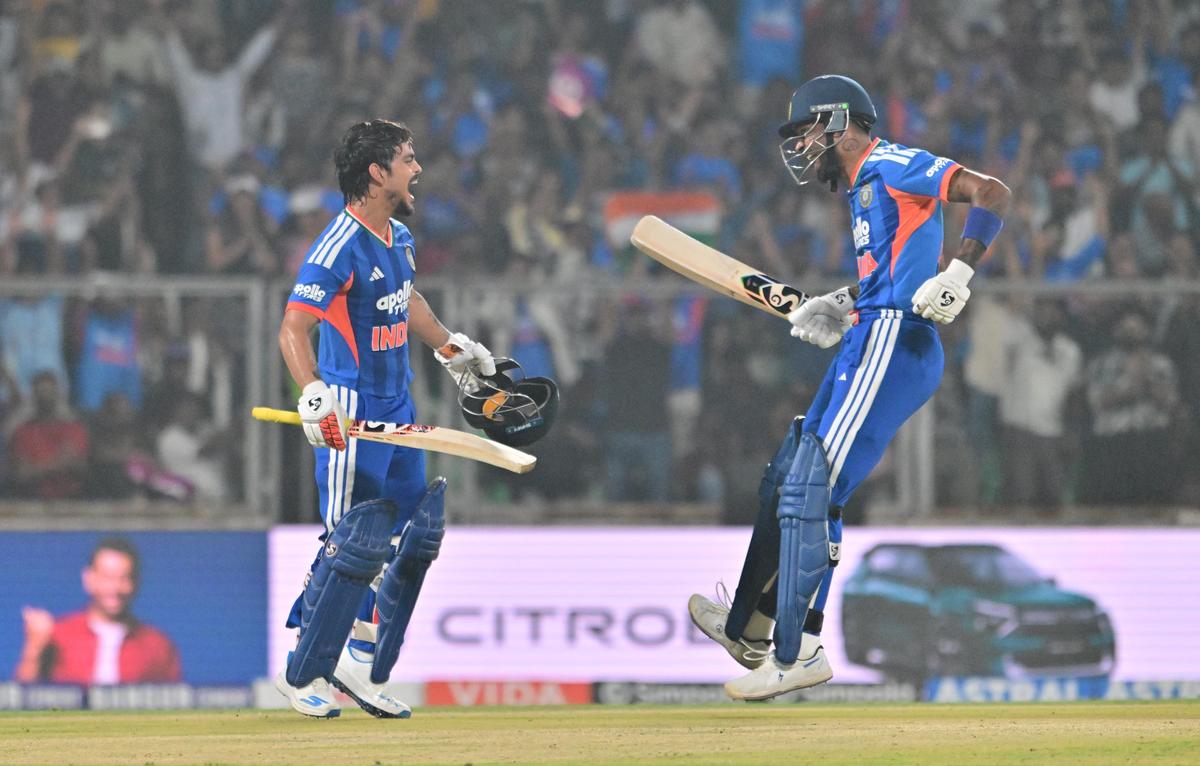
India’s Ishan Kishan celebrates with Hardik Pandya after scoring a century in Thiruvananthapuram.
| Photo Credit:
NIRMAL HARINDRAN
Kishan has now made himself undroppable, so to say. Even had Samson hit a rich vein of form, it would have been impossible to overlook the younger man’s credentials, but now, it is almost a no-brainer that Kishan will be India’s preferred opener/wicketkeeper at the World Cup. Once Tilak is back in the fray — and that could be as early as in the opener against United States on Saturday — then Samson will have to make way, a reality that the 31-year-old must all too painfully be aware of. He will also know that he has no one else to blame but himself, but he will not grudge Kishan his success because that’s not how he is wired.
The ultimate non-vocal confirmation that Kishan has zoomed ahead of Samson in the selection debate came when he was entrusted with the big gloves as India set out to defend their tally of 271 for five, their third highest T20I total. Hitherto, it was Samson behind the sticks and Kishan manning the outfield, scurrying around busily as he used his short but powerful strides to great effect. Kishan will be the first to concede that he didn’t have a great time behind the stumps, spurning a couple of straightforward stumping opportunities, but that can happen when one hasn’t kept wickets in a game situation for a while, even if one has spent plenty of time at practice ensuring that the primary — or is it now secondary? — skill isn’t ignored.
India have an enviable arsenal of aggressive riches, with the icing on the cake coming in the shape of Suryakumar, who shed a horrendous patch in 2025 by winning the Player-of-the-Series award, rediscovering his mojo. Because India bat deep, and because each of their batters is capable of taking down the best attacks — in this series alone, 21- and 22-ball half-centuries seem passe, given that Abhishek Sharma got there in 14 and Shivam Dube in 15 — there is one uninterrupted burst from ball one to 20. The strapping Abhishek and the pocket dynamite that Kishan is, now that is the perfect launchpad from which to wreak untold mayhem. Excitingly mouth-watering for everyone, except those in the opposition who have good reason to fear the worst.