




How ambient fragrancing is reshaping wellness in urban Indian homes
Traditionally, the scents of an Indian home were described as strong. The strong smoke of agarbatti during puja, the clammy scent of turmeric and cumin from the kitchen, the sharp smell of phenyl during cleaning, were distinctive features of the scentscape of an Indian home. There is, however, a quieter and more conscious olfactory revolution that is happening now.
Urban Indian households have not only moved away from strong, singular scents, but have also accepted ambient fragrancing — the subtle and continuous diffusion of scent to create a certain atmosphere. It is not only about making the room smell good, but also about creating a sensory environment for mental and emotional health.
Wellness reimagined
The movement is an outcome of mixing different global trends with the resuscitation of local wisdom. Take, for example, the wellness industry that has endorsed aromatherapy over the years, even connecting scents to the limbic system, which is the part of the brain that handles emotions and memories. The COVID-19 pandemic and subsequent lockdowns gave rise to stress and screen fatigue, and the demand for personal sanctuaries at home grew.
Scented living spaces help individuals take control of their immediate environment. The living room can become a soothing retreat, while the home office can be turned into a focused concentration area.
Ritual to routine
What is it that makes this trend so strong in India? The answer lies in its perfect blend with ancient practices. The use of incense and floral offerings in rituals was never purely symbolic. It also served as an environmental scenting technique for spiritual purification and mood enhancement. Modern ambient fragrancing is a secular, personal extension of the ancient practice. It uses its essence and refines it for everyday use.
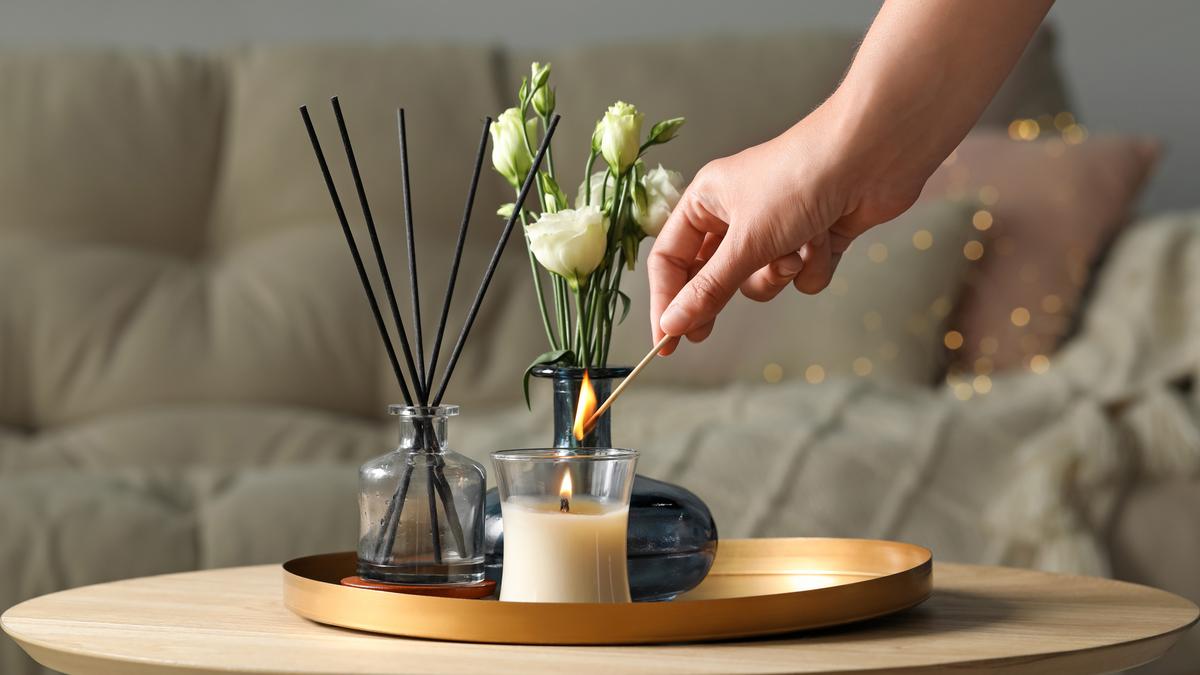
Today, it provides customers with a choice of diffusers (ultrasonic, nebulising, or reed), scented candles with natural waxes, and room mists that use high-quality essential oils. Scents are now selected according to the time of day and the purpose of the area: the kitchen gets invigorating citrus and peppermint in the morning; the bedroom gets calming lavender, chamomile, or Indian vetiver (usira) to aid sleep; and the living area gets grounding sandalwood (chandan) or frankincense (loban) for promoting mindfulness and conversation.
In congested urban areas, where an individual’s seclusion is restricted, fragrance appears to be a powerful factor in the overall interior design concept. A diffuser located in a corner releasing a barely perceptible mist of bergamot and cedarwood not only fills the room with fragrance, but it makes space for tranquillity — a limit set against the noise from outside.
Passive self-care
Ambient scenting can be considered a form of passive self-care. It works quietly and without being noticed, but it constantly raises one’s mood and mindset without taking time or effort. For those with busy lives, the existence of this silent and constant support is valuable.
To put it simply, the transition from transient candles to discreet ambient scenting represents a major step forward by the Indian wellness consumer. The combination of scent neuro-science with Indian spiritual aroma practices has resulted in the country’s houses not just emitting a pleasant fragrance, but also being more alive. The home air is slowly being accepted as one of the essentials for domestic well-being rather than just an afterthought.
The writer is founder & CEO of Saraf Furniture.
Published – January 23, 2026 05:36 pm IST