




India-UAE ties — stability, substance, strategic union
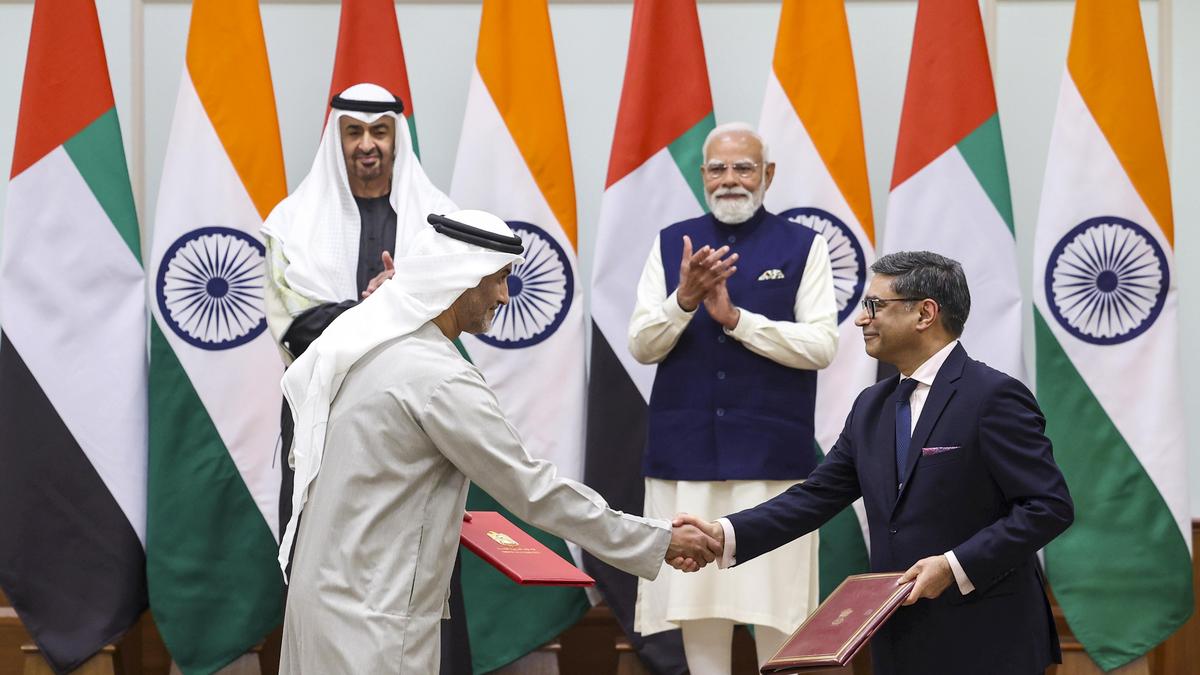
At a time of significant churn in global geopolitical equations, relations between India and the United Arab Emirates (UAE) stand out for their remarkable stability and a steady deepening. The very brief visit of UAE President Sheikh Mohamed bin Zayed Al Nahyan (MbZ) to India, last week, was a clear reflection of this robustness. The January 19, 2026 visit was substantive, outcome-oriented and strategically significant. This visit, the eleventh at the leadership level in as many years, shows the mutual importance the countries accord to each other.
Editorial | Bridging the Gulf: On India, defence ties with Gulf nations
A continuity
Since MbZ’s last visit in January 2024 as the chief guest at the Vibrant Gujarat Global Summit, two other high-profile engagements have reinforced bilateral momentum. At the Prime Minister’s personal invitation, the Crown Prince of Abu Dhabi, Sheikh Khaled bin Mohamed bin Zayed, and the Crown Prince of Dubai, Sheikh Hamdan bin Mohammed Al Maktoum, visited India, yielding concrete outcomes across sectors such as defence, nuclear cooperation, energy, education and economic engagement. The active participation of the next generation of Emirati leadership lends a distinctive depth and continuity to the India-UAE partnership.
Following the signing of the Comprehensive Strategic Partnership Agreement in 2017, the relationship has evolved in a genuinely comprehensive manner. MbZ’s latest visit produced a wide-ranging set of outcomes, including a defence cooperation framework, a joint space initiative, a target of $200 billion in bilateral trade, collaboration in artificial intelligence, data embassies, infrastructure investment, partnership on small nuclear reactors, a supercomputing cluster in India, and a 10-year LNG supply agreement.

The signing of a Letter of Intent towards a Strategic Defence Partnership is timely, given the evolving defence architecture in parts of West Asia. Equally significant was the unequivocal joint condemnation of terrorism in all its forms, and the emphasis that no country should provide a safe haven to those who finance, plan, or perpetrate such acts.
Infrastructure investment
The UAE’s interest in India’s infrastructure story is well established. The Abu Dhabi Investment Authority (ADIA)’s $1 billion commitment to India’s National Investment and Infrastructure Fund (NIIF) Master Fund in 2017 was an early signal. Since then, UAE entities have emerged as key long-term substantial investors.
Ongoing discussions on the UAE’s participation in developing the Special Investment Region in Dholera, Gujarat reflect this commitment. The envisaged partnership covers strategic assets including an international airport, pilot training facilities, maintenance and repair infrastructure, a greenfield port, a smart urban township, rail connectivity and energy infrastructure.

Investor interest in Dholera has been reinforced by successful roadshows in the UAE, where sovereign wealth funds and institutional investors have shown a strong appetite. Dholera’s appeal lies in its status as a government-backed smart city, with advanced connectivity and utilities, anchor investments by major corporates, focus on high-technology sectors such as semiconductors and electric vehicles, and its potential as a future hub within the Delhi-Mumbai Industrial Corridor. The announcement that DP World and First Abu Dhabi Bank will establish offices in GIFT City further enhances its profile as an emerging international financial centre. These offices will serve as critical bridges connecting Indian companies with the Gulf Cooperation Council (GCC) and Middle East and Northern Africa markets. ADIA already operates from GIFT City, reinforcing the UAE’s long-term financial engagement with India. Buoyed by the strong performance of the Comprehensive Economic Partnership Agreement (CEPA), which has led to a 37% rise in bilateral trade since FY 2022–23, leaders have set an ambitious target of $200 billion in trade by 2032. India’s exports to the UAE grew by 28% last year to $36 billion, while imports rose by 41% to $64 billion, making the target realistic. This expansion could partly offset export pressures arising from unilateral tariff measures elsewhere. Beyond trade volumes, CEPA has significantly deepened trust between businesses and investors on both sides.
Initiatives such as Bharat Mart at Jebel Ali will provide a major boost to India’s MSME exporters. The proposed Bharat-Africa Setu aims to connect Indian exporters with markets across Africa by leveraging DP World’s logistics footprint. The Virtual Trade Corridor announced during Sheikh Khaled’s visit is close to becoming operational and could also support broader connectivity initiatives such as the India-Middle East-Europe Economic Corridor.
Building on the MoU on civil nuclear cooperation signed in September 2024, the decision to explore partnerships in advanced nuclear technologies, including large reactors, small modular reactors, operations and safety, is particularly significant. With the UAE generating nearly a quarter of its electricity from nuclear power, complementarities are evident, especially in the context of India’s clean energy ambition.
The overview
The significance of MbZ’s visit extends beyond announced deliverables. Recent intra-GCC political dynamics could have wider regional implications. India, with deep stakes across West Asia, must continue to carefully recalibrate its relationships, guided by strategic autonomy and multi-alignment, while avoiding entanglement in regional rivalries. The India-UAE partnership, anchored in trust and shared interests, offers a stable pillar amid regional uncertainty.
Sunjay Sudhir is Distinguished Fellow, JSW School of Public Policy at the Indian Institute of Management Ahmedabad (IIMA), and a former Ambassador to the United Arab Emirates and the Maldives
Published – January 26, 2026 12:08 am IST